


Choosing the right leather travel bag for long trips comes down to five specific factors: capacity that matches your actual trip length without becoming oversized, structural integrity that handles airline baggage handling without damage, interior organisation that supports living out of the bag for days at a time, ergonomic carry options for moving through airports and hotels, and full-grain leather construction that justifies the investment across decades of travel ahead.
A mens travel bag leather suitable for trips of 7-14 days needs different specifications than a weekend bag - more capacity, better organisation, more durable construction, and travel-specific features like trolley sleeves and luggage tags. The right leather travel bag is one you use confidently for the first trip and continue using for every trip across the next 15-20 years - the bag becomes a travel companion rather than a constant point of replacement.
The travel bag category is where most travellers compromise unnecessarily. The popular options are either oversized luggage that requires checking on every flight, undersized weekenders that force overpacking and forgotten essentials, or fashion travel bags that look right in airport lobby photos but fail under actual baggage handling stress. A real leather travel bag for long trips is none of these - it is a purpose-built carrier that handles 7-14 day trips reliably, looks better with every journey, and lasts decades of travel use that justifies its investment cost across the long ownership horizon.
This guide covers exactly what makes the right mens travel bag leather for long trips: the size and capacity that fits 7-14 days without excess, the structural specifications that survive airline baggage handling, the interior organisation that supports extended trip living, the carry options that work through airports and hotels, the leather grade and construction that justifies the investment, and the questions that determine which specific bag matches your specific travel pattern.

Rustic Town's leather travel bag collection - full-grain leather, reinforced construction, trolley sleeves, handcrafted in Delhi from under $180.
What Size Leather Travel Bag Do You Need for Long Trips?
Size selection is the most critical decision in choosing a leather travel bag for long trips - and the decision where buyers most frequently choose wrong. Most select for the longest possible trip rather than the most common trip, resulting in oversized bags that encourage overpacking on every journey and create unnecessary bulk through airports.
How Long Does a Long Trip Actually Last?
'Long trip' means different things to different travellers. For business travellers, long typically means 5-10 days. For leisure travellers, long typically means 7-14 days. For extended travel and sabbaticals, long means 2-4 weeks or more. The right leather travel bag capacity matches your actual long-trip duration, not the theoretical maximum trip you might take once a decade. A 7-day trip and a 14-day trip require meaningfully different capacities - choose for what your travel pattern actually involves.
For most travellers, the sweet spot for long-trip capacity is 50-65 litres. A 50-litre leather weekender bag handles 5-7 days of travel comfortably. A 60-litre leather travel bag handles 7-10 days. A 65-litre option stretches to 10-14 days with deliberate packing. Beyond 65 litres, the bag becomes properly large luggage that requires checking on flights and becomes cumbersome to carry through hotels and ground transport. For trips longer than 14 days, the right approach is usually a 60-65 litre bag combined with airport laundry rather than going larger.
What Dimensions Match the Capacity?
A 50-litre leather travel bag is approximately 55cm long x 35cm tall x 28cm deep. A 60-litre mens travel bag leather is approximately 60cm long x 38cm tall x 30cm deep. A 65-litre leather duffle travel bag reaches approximately 65cm long x 40cm tall x 32cm deep. These dimensions matter for airline carry-on compliance (most airlines allow up to 56x45x25cm for cabin baggage), hotel storage in compact rooms, and ground transport in taxis and ride shares.
|
Trip Length |
Recommended Capacity |
Approximate Dimensions |
Cabin or Check? |
Notes |
|
2-3 days |
30-40 litres |
50x32x25cm |
Cabin |
Standard weekender size |
|
4-6 days |
40-50 litres |
55x35x28cm |
Cabin or check |
Right size for short business trips |
|
7-10 days |
50-60 litres |
60x38x30cm |
Check on most airlines |
Right for most leisure long trips |
|
10-14 days |
60-65 litres |
65x40x32cm |
Check |
Right for extended business or leisure |
|
14-21 days |
65-70 litres + supplement |
Beyond cabin dimensions |
Check |
Combine with laundry or supplement bag |
|
3+ weeks |
60-65 litres + supplement |
As above |
Check |
Bag plus on-trip laundry rotation |
What Structural Features Make a Real Long-Trip Leather Travel Bag?
Not every leather bag described as a travel bag is structurally suitable for long trips. The category includes weekenders sized for 2-3 day use being marketed for longer trips, decorative leather bags that look right in product photos but fail under actual airline baggage handling, and undersized duffles that are marketed as 'travel-ready' but cannot accommodate the realities of extended travel. A real full grain leather travel bag for long trips has specific structural features.
What Are the Critical Structural Features?
Reinforced base panel with feet.
The base of a leather travel bag takes the most punishment - dropped on airport tile, set on hotel floors, slid into baggage compartments, dragged when handled roughly. A reinforced base panel with metal feet (typically four brass or steel feet at the corners) elevates the leather above contact surfaces and prevents wear at the bottom. Without reinforced base and feet, the bottom of the bag develops worn patches and structural weakness within months of regular travel use.
Structured sidewalls and end panels.
The sidewalls of a leather weekender bag need internal structure to maintain shape under load and during transit. Unstructured leather sidewalls collapse in transit, compress contents, and produce the deflated silhouette that makes the bag look badly packed and looks bad in luggage compartments. Structured sidewalls keep the bag's silhouette consistent whether empty or fully packed.
Reinforced handle attachment.
The handles of a long-trip travel bag carry the full weight of 7-14 days of contents - typically 12-18kg when fully packed. The handle attachment points are the most stress-prone area of the bag. Reinforced stitching, metal rivets, and quality leather construction at the handle attachments are non-negotiable for a real mens travel bag leather. Cheap handles fail or stretch under the sustained loaded carry of actual travel use.
Quality zipper running the full length.
The main compartment zipper on a leather travel bag runs across a long distance and operates hundreds of times across the bag's lifetime. Quality zippers (YKK or equivalent) with reinforced zipper tape and substantial pulls last across years of use. Cheap zippers fail at the curves where the zipper changes direction - typically the first failure point of cheaper travel bags.
Trolley sleeve on the back panel.
A pass-through sleeve on the back of the bag that fits over a roller suitcase handle is a critical feature for travel-frequent users. The sleeve allows the leather travel bag to ride on top of a wheeled suitcase through airports rather than being carried throughout. This is particularly important for users who combine the travel bag with checked luggage.
Multiple carrying options.
A quality long-trip leather travel bag typically offers three carrying options: dual top handles for two-hand carry, an adjustable shoulder strap for over-the-shoulder carry, and possibly side grab handles for lifting into overhead bins or out of car boots. The multiple options match different transit contexts - top handles for the walk to the gate, shoulder strap for longer terminal walks, grab handles for lifting.
|
Feature |
Why It Matters |
Importance |
What Failure Looks Like |
|
Reinforced base + feet |
Protects leather from contact wear |
Critical |
Base wear, surface damage, structural weakness |
|
Structured sidewalls |
Maintains shape under load |
Very important |
Collapsed silhouette, crushed contents |
|
Reinforced handle attachment |
Bears full weight of loaded bag |
Critical |
Handle stretching or failure |
|
Quality main zipper (YKK) |
Daily-use closure mechanism |
Critical |
Zipper failure makes bag unusable |
|
Trolley sleeve |
Travel ergonomics |
Critical for travel |
Limits multi-bag travel comfort |
|
Multiple carry options |
Matches different transit contexts |
Very important |
Limited carry flexibility |
|
Quality stitching at stress points |
Structural longevity |
Critical |
Seam failure under load |
|
Padded shoulder strap |
Sustained carry comfort |
Very important |
Strap discomfort over long carry |
See Rustic Town's full grain leather travel bag range - all built with reinforced base, structured sidewalls, and travel-specific features.
What Interior Organisation Does a Long-Trip Travel Bag Need?
Living out of a leather travel bag for 7-14 days requires interior organisation that supports the trip rather than fighting it. A bag with a single undivided compartment may work for a weekend but becomes frustrating across an extended trip. The right interior organisation transforms how the trip feels.
What Specific Interior Features Matter for Long Trips?
A dedicated shoe compartment.
Long trips typically involve carrying 2-3 pairs of shoes alongside the main wardrobe. A dedicated shoe compartment - typically a separate end pocket or zipped section - isolates shoes from clothes. This prevents shoe contact transfer onto clothing and provides quick access to the shoes without unpacking the entire bag. The compartment should accommodate at least one pair of standard shoes.
Multiple internal zip pockets at different positions.
Three to four internal zip pockets at varying positions - top, middle, base - prevent everything from settling at the bottom of the main compartment. Top pockets for items accessed daily (chargers, daily medications, electronics). Middle pockets for valuables (wallet, passport, documents). Base pockets for items packed but rarely accessed. This vertical organisation is what makes living out of the bag for days actually work.
Compression straps or interior straps.
Interior straps that secure folded or rolled clothing prevent shifting during transit. Compressed contents stay organised through the journey rather than mixing up and forcing repacking on arrival. A quality leather duffle travel bag includes interior compression straps that maintain organisation through baggage handling and ground transport.
A separate compartment for dirty clothes.
Across a 10-day trip, dirty clothes accumulate. A separate compartment or laundry pouch for dirty clothes prevents mixing with clean clothes. This is one of the most useful but commonly omitted features in a long-trip leather travel bag. If the bag does not have a dedicated dirty clothes compartment, plan to include a laundry bag inside as part of your packing.
Quick-access exterior pockets.
Exterior pockets for items accessed during transit without opening the main compartment: travel documents, passport, phone charger, transit pass, sunglasses. Multiple exterior pockets at different positions create the access structure that supports the actual workflow of long-trip travel - getting through airports, taxis, hotels, and ground transport with minimal main bag opening.
A dedicated electronics compartment with padding.
Modern long-trip travel typically includes laptop, tablet, e-reader, chargers, and cables. A padded electronics compartment - typically a separate zipped section against the back panel - protects valuable electronics from impact and contact with other contents. Without dedicated electronics protection, devices risk damage from being packed against shoes, luggage hardware, or sharp objects.
RFID-blocking pocket for travel documents and cards.
A dedicated RFID-blocking pocket protects passport, credit cards, and ID from skimming during airport and transit movement. Increasingly common in quality travel bags. Important for international travel where document and card protection matters.

|
Feature |
Trip Length Where Critical |
Position |
Why It Matters |
|
Dedicated shoe compartment |
All long trips |
End or separate section |
Isolates shoes from clothing |
|
Multiple internal zip pockets |
5+ day trips |
Top, middle, base |
Vertical organisation prevents excavation |
|
Interior compression straps |
All long trips |
Inside main compartment |
Maintains organisation through transit |
|
Dirty clothes compartment |
7+ day trips |
Separate from main |
Prevents mixing across long trips |
|
Quick-access exterior pockets |
All trips |
Front and sides |
Transit workflow without main bag opening |
|
Padded electronics compartment |
Business and modern travel |
Back panel |
Protects valuable electronics |
|
RFID-blocking pocket |
International travel |
Internal |
Document and card security |
|
Water bottle holder |
Active travel |
Side or interior |
Hydration without leak risk |
Rustic Town's leather weekender bag range with full long-trip interior organisation - shoe compartments, electronics protection, multiple zip pockets.
How to Choose the Right Leather Travel Bag for Long Trips: A Step-by-Step Guide
Here is the framework for choosing the right leather travel bag for your specific long-trip pattern - not a generic approach but one that produces the right choice consistently.
Step 1. Define your typical long trip honestly.
What is your most frequent long trip length? Business travel of 5-7 days? Leisure travel of 10-14 days? Extended travel of 2-3 weeks? Choose your leather travel bag capacity for your typical trip, not the theoretical maximum. An oversized bag used regularly is worse than a correctly-sized bag with occasional laundry stops on longer trips.
Step 2. Identify your dominant travel mode.
Frequent flyer with checked luggage. International business traveller with cabin-only carry. Road trip and ground transport. Mixed mode. The travel mode determines the size constraints, carry requirements, and feature priorities. International cabin travel demands strict sizing compliance. Road trip travel allows larger flexibility.
Step 3. List the realistic content categories you carry.
Clothing for 7-14 days. Shoes (typically 2-3 pairs). Electronics (laptop, tablet, accessories). Toiletries (separate pouch). Documents. Personal items. Books or reading material. The realistic content inventory determines the capacity and organisation features needed. A mens travel bag leather for business needs different features than one for leisure.
Step 4. Verify the leather grade is full-grain.
Confirm the product is described as full-grain leather. A full grain leather travel bag lasts 15-20+ years of regular travel use. Bonded and PU 'leather' travel bags fail under the structural stress of airline baggage handling within 1-3 years. Travel bags experience more sustained stress than most leather goods - the leather grade matters significantly.
Step 5. Test the carry options for your specific use.
Try the bag with realistic loaded weight (12-15kg if possible). The top handles should feel substantial and comfortable. The shoulder strap should distribute weight well across the shoulder. The grab handles should be properly positioned for lifting. The trolley sleeve should fit a standard roller suitcase handle. Verify all carry options work for how you actually carry.
Step 6. Verify the structural features that matter.
Check the base for reinforced construction and metal feet. Verify the sidewalls maintain shape. Confirm the main zipper feels substantial and runs smoothly. Check handle attachment for reinforced construction. These structural features distinguish a real leather travel bag from a decorative one. Most failures occur at these specific points.
Step 7. Confirm the interior organisation matches your needs.
Open the bag and verify the interior organisation supports your travel pattern. Shoe compartment if you carry multiple pairs. Multiple zip pockets if you organise across categories. Electronics protection if you travel with valuable devices. RFID protection if you travel internationally. Match the interior to how you actually travel.
Step 8. Consider the long-term ownership economics.
A quality full-grain leather travel bag at $180-$350 used for 15-20 years of regular travel costs $10-$20 per year. A synthetic travel bag at $100 replaced every 2-3 years costs $35-$50 per year over the same period. The full-grain bag is the cheaper option per year across any meaningful travel timeline - while looking better with every trip.
What Are the Different Types of Leather Travel Bags for Long Trips?
Leather travel bags come in several distinct formats, each suited to different travel patterns. Understanding the format options helps match the bag to your specific travel reality.
What Is a Leather Duffle Travel Bag?
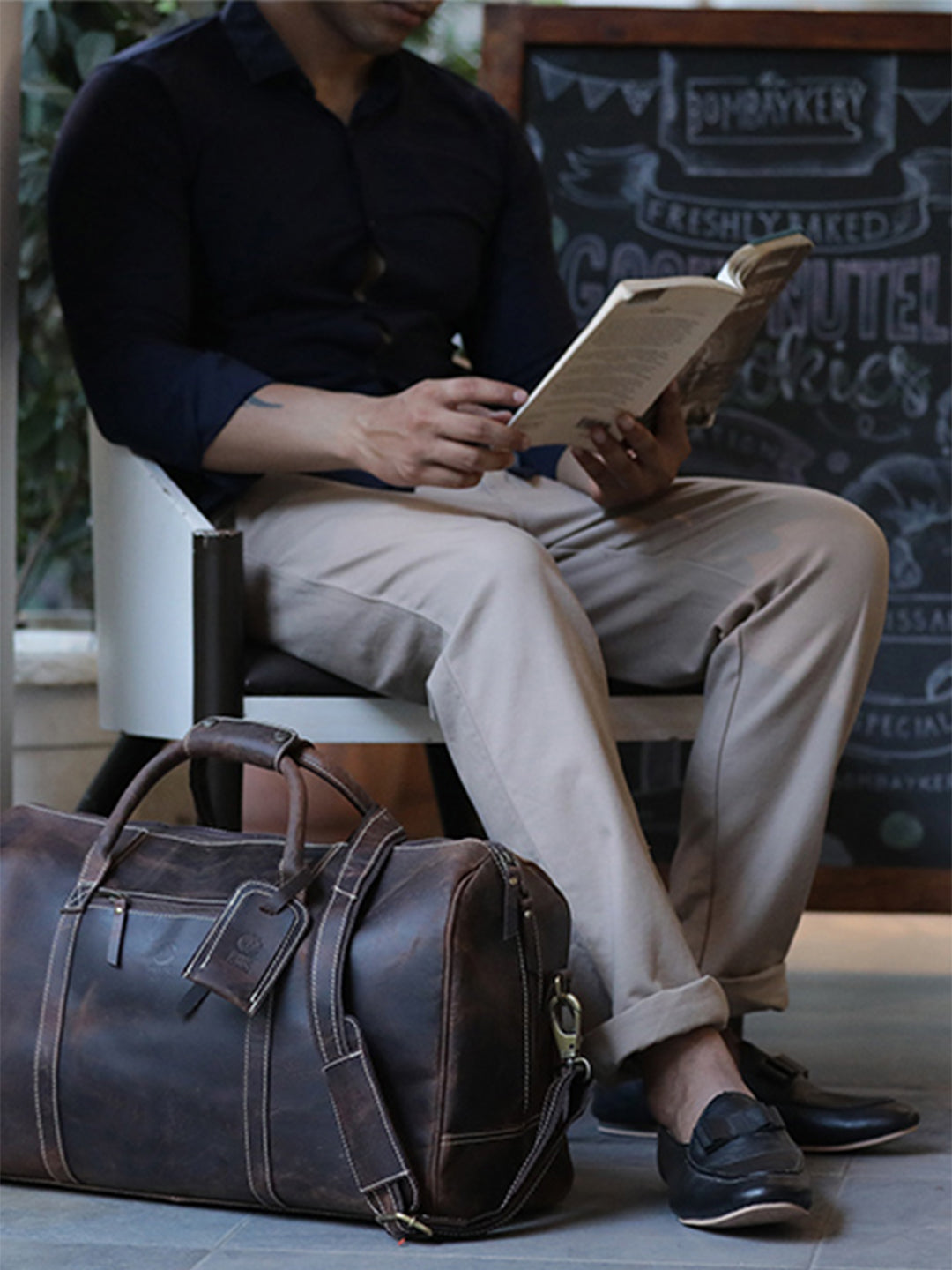
A leather duffle travel bag is the most common long-trip format - a cylindrical or rectangular soft-sided bag with dual top handles and a shoulder strap. The duffle silhouette is the traditional travel bag shape, refined over decades for travel use. Duffles work for trips of 5-14 days, handle airline cabin and check use equally well, and pair naturally with roller suitcases via the trolley sleeve. The 'leather duffle' is the most versatile long-trip travel bag format.
What Is a Leather Weekender Bag?
A leather weekender bag is a smaller travel bag specifically sized for 2-4 day trips. Despite being marketed as 'weekenders,' some weekender models extend to 5-7 day use depending on packing efficiency. Weekenders typically have 30-45 litre capacity. For long trips of 7+ days, a weekender is usually undersized unless combined with checked luggage. Choose a weekender when your typical 'long trip' is actually short, or when you want a bag for shorter business and leisure travel.
What Is a Leather Holdall?
A 'holdall' is a British term for a large travel bag - similar to a duffle but often with more structured construction and additional features. Leather holdalls work for 7-14 day trips and frequently include dedicated shoe compartments, multiple pockets, and trolley sleeves. The holdall format is particularly popular for traditional masculine travel aesthetic and senior business travel.
What Are Leather Travel Backpacks?
A leather travel bag in backpack format combines travel capacity with backpack ergonomics. Travel backpacks typically have 30-50 litre capacity, dedicated laptop compartments, and travel-specific features like passport pockets and water bottle holders. Best for travellers who walk significant distances or use public transport at destinations. The two-shoulder carry advantage makes travel backpacks particularly suitable for active travel and city-based trips.

|
Format |
Capacity |
Best For |
Typical Trip Length |
Pros / Cons |
|
Leather duffle |
40-65 litres |
Most long trips, business and leisure |
5-14 days |
Versatile, travel-tested format / less structured |
|
Leather weekender |
30-45 litres |
Short to medium trips |
2-7 days |
Compact, cabin-friendly / undersized for longer trips |
|
Leather holdall |
45-65 litres |
Traditional masculine travel |
7-14 days |
Structured, masculine signal / heavier, less flexible |
|
Leather travel backpack |
30-50 litres |
Active travel, walking destinations |
5-10 days |
Ergonomic, hands-free / smaller capacity than duffle |
|
Leather suitcase |
60-100 litres |
Formal traditional travel |
10+ days |
Most capacity / heavy, formal only |
|
Garment bag |
Specific to suits |
Business travel with suits |
1-7 days with suits |
Suit protection / single-purpose |
Browse Rustic Town's leather duffle travel bag range - the most versatile format for long-trip travel.
How Do You Pack a Leather Travel Bag Efficiently for Long Trips?
Owning the right leather travel bag is the start. Packing it efficiently for long trips is what makes the bag function as the travel tool it should be. Here is the framework for efficient long-trip packing.
What Are the Core Packing Principles for Long Trips?
Roll clothes rather than fold for soft items.
Rolling t-shirts, casual trousers, soft tops, and jumpers maximises space significantly compared to folding. Rolling produces 20-30% more capacity from the same bag. Folded items create air gaps; rolled items pack tighter. Reserve folding for formal pieces that need to arrive un-wrinkled (suits, dress shirts) - these go in garment bags or at the top of the main compartment.
Pack heavy items at the base of the bag.
Shoes, toiletries, books, and dense items go at the base of the leather travel bag for stable weight distribution and to prevent crushing lighter contents. Light items at the top, heavy items at the base. This packing order matches gravity and produces a bag that does not crush its own contents during transit.
Use packing cubes or organisation pouches.
Packing cubes inside a mens travel bag leather create organised sections within the main compartment. One cube for tops, one for bottoms, one for accessories. This transforms an undivided main compartment into a structured filing system that supports living out of the bag for 7-14 days without losing track of contents.
Plan a laundry rotation for trips longer than 10 days.
For trips beyond 10 days, hotel laundry, drop-off laundry services, or self-service laundry rotates clothing through the trip rather than packing exhaustively. This allows a 60-litre leather travel bag to handle a 2-3 week trip that would otherwise require oversized luggage. Plan laundry stops at the midpoint of long trips.
Keep documents and electronics accessible.
Pack frequently accessed items in exterior pockets and quick-access compartments rather than buried in the main compartment. Passport, boarding passes, phone, charger, headphones, and travel documents need to be reachable without opening the main bag. This packing approach respects the practical workflow of transit.
Plan for return trip volume increase.
Travel bags fill more on the return than the departure - souvenirs, gifts, additional purchases. Pack the outbound 80% full to leave 20% capacity for return additions. A full grain leather travel bag that is exactly full on departure becomes overstuffed on return, straining handles and structural integrity.
Find Rustic Town's complete leather luggage range - duffles, weekenders, and travel goods for every long-trip pattern.
How Do You Care for a Leather Travel Bag to Make It Last Decades?
A leather travel bag sees more environmental stress than most leather goods - airline baggage handling, weather exposure, multiple climates across trips, sustained loaded carry. Proper care extends the lifespan significantly.
|
Action |
Method |
Frequency |
Why |
|
Wipe exterior after each trip |
Dry cloth on all surfaces |
Every return |
Removes travel grime and contamination |
|
Empty interior and air |
Remove all contents, leave bag open |
Every return |
Prevents moisture and odour accumulation |
|
Condition leather |
Beeswax or lanolin conditioner |
Every 4-6 months or after heavy travel |
Replenishes oils depleted by weather and use |
|
Inspect stress points |
Handle attachments, zipper, base |
Every trip |
Catches early wear before failure |
|
Treat water exposure |
Blot and air dry at room temp |
Immediately |
Prevents water staining |
|
Polish brass hardware |
Brass polish on hardware |
Every 12 months |
Maintains hardware appearance |
|
Clean interior fabric |
Vacuum lightly |
Every few trips |
Removes accumulated debris |
|
Storage between trips |
Dust bag, stuffed lightly |
When unused for weeks |
Maintains shape, protects from dust |
Browse Rustic Town's complete mens travel bag leather collection - all with care guides for 15-20 years of travel use.
Frequently Asked Questions: Leather Travel Bags for Long Trips
Q: What size leather travel bag is right for a 10-day trip?
A: A 50-60 litre leather travel bag is the right size for most 10-day trips. This capacity handles 7-10 days of clothing, shoes, electronics, and daily essentials without becoming oversized. Larger than 65 litres becomes cumbersome through airports and hotels. Smaller than 45 litres forces overpacking and forgotten essentials.
Q: Can a leather travel bag survive airline baggage handling?
A: Yes - a quality full-grain leather travel bag with reinforced base, structured sidewalls, and quality stitching handles airline baggage handling without significant damage. Cheaper bonded or PU 'leather' travel bags fail under the same stress within 1-3 years. The structural specifications matter more than the leather alone.
Q: How long does a quality leather travel bag last?
A: A full-grain leather travel bag with proper care lasts 15-20+ years of regular travel use. Many leather travel bags from 20-30 years ago are still in active travel use today. The leather develops increasingly beautiful patina across the years and decades of use - a leather travel bag at year 10 looks better than year 1, not worse.
Q: Should a travel bag be cabin or check size?
A: Depends on your travel pattern. International travel and budget airlines increasingly require check baggage for bags over 56x45x25cm. Most quality long-trip leather travel bags (50-65 litres) require checking on most airlines. For travellers who prefer cabin-only travel, a 40-litre weekender is the largest typically cabin-compliant size.
Q: What is the difference between a leather duffle and a leather weekender?
A: A leather duffle is typically larger (40-65 litres) and suited for 5-14 day trips. A leather weekender is smaller (30-45 litres) and suited for 2-7 day trips. The naming conventions vary by brand, but the size and capacity distinguish them functionally - duffle for longer trips, weekender for shorter trips.
Q: Do leather travel bags have wheels?
A: Most quality leather travel bags do not have wheels - they are designed for carry rather than rolling. For wheeled options, look at leather suitcases or leather travel bags specifically designed with wheels. Many travellers prefer the trolley sleeve approach - the leather travel bag rides on top of a separate roller suitcase rather than having integrated wheels.
Q: What is the best colour for a leather travel bag?
A: Brown shades (tan, cognac, chocolate) are the most popular and versatile for leather travel bags. Black works for formal business travel. Burgundy and forest green work for distinctive style. Avoid lighter colours for travel use - they show wear and dirt more quickly than darker tones. Tan or cognac is the safest universal choice.
Q: Are leather travel bags worth the investment?
A: For frequent travellers and those who travel more than 5-10 times per year, yes. The 15-20 year lifespan of a quality leather travel bag amortises the higher upfront cost across many trips. For infrequent travellers (under 5 trips per year), a quality canvas or synthetic alternative may be more practical. Frequency of use is the deciding factor.
The Short Answer: How to Choose the Right Leather Travel Bag for Long Trips
Choose a leather travel bag for long trips by matching five specific factors: capacity that fits your typical long-trip length (50-65 litres for 7-14 day trips), structural integrity that handles airline baggage handling (reinforced base, structured sidewalls, quality zipper), interior organisation that supports extended living out of the bag (shoe compartment, multiple zip pockets, electronics protection), ergonomic carry options for transit (dual handles, shoulder strap, trolley sleeve), and full-grain leather construction that justifies the investment across decades. The right mens travel bag leather handles your travel pattern reliably from the first trip and continues for 15-20 years.
The most common mistake is choosing capacity for the theoretical maximum trip rather than the typical trip. An oversized leather weekender bag used regularly is worse than a correctly-sized bag with occasional laundry stops on longer journeys. The second most common mistake is choosing a bag that looks right in product photos but lacks the structural features that survive actual airline baggage handling - reinforced base, quality stitching at stress points, substantial zippers, properly attached handles.
Invest in full-grain quality. Match the capacity to your typical long trip. Verify the structural features that determine longevity. Choose interior organisation that supports your travel pattern. Care for the bag properly between trips. The result is a full grain leather travel bag that becomes more beautiful with every trip, lasts 15-20+ years, and serves as a travel companion across the decades of journeys ahead.
Find Rustic Town's complete leather luggage and travel bag collection - full-grain leather, reinforced construction, handcrafted in Delhi for 15-20 years of travel use.