


The choice between a backpack for documents and a briefcase comes down to four factors: how long you carry the bag daily, how formal your professional environment is, how heavy your typical document load actually is, and whether you commute by foot/transit or by car/taxi. The backpack vs briefcase decision is not about which is universally better - both have specific contexts where they excel.
A leather backpack for work wins for sustained daily carry, ergonomic comfort, and modern professional aesthetics. A briefcase wins for highly formal environments, short-distance carry, and traditional professional signal. Most professionals who carry documents daily benefit from owning both - a backpack for sustained commute days and a briefcase for high-formality client meetings - rather than forcing one to serve every context.
The traditional answer to backpack vs briefcase used to be simple: briefcase for serious professionals, backpack for students. That binary no longer holds. Senior consultants, partners at law firms, finance executives, and C-suite leaders increasingly carry quality leather backpacks to work because the practical benefits - hands-free commute, weight distribution across both shoulders, capacity for documents plus laptop plus daily essentials - now outweigh the traditional formality signal of a briefcase.
The professional carry conversation has shifted, and the right answer depends on your specific working reality rather than what was correct 20 years ago.
This guide covers exactly when a backpack for documents is the right choice, when a briefcase is the right choice, what specifications matter in each format for serious document carry, how to choose between them based on your actual professional context, and the practical realities that determine which format serves you better across the working week. By the end, the choice between options is clear rather than weighted by outdated assumptions about what professional carry should look like.

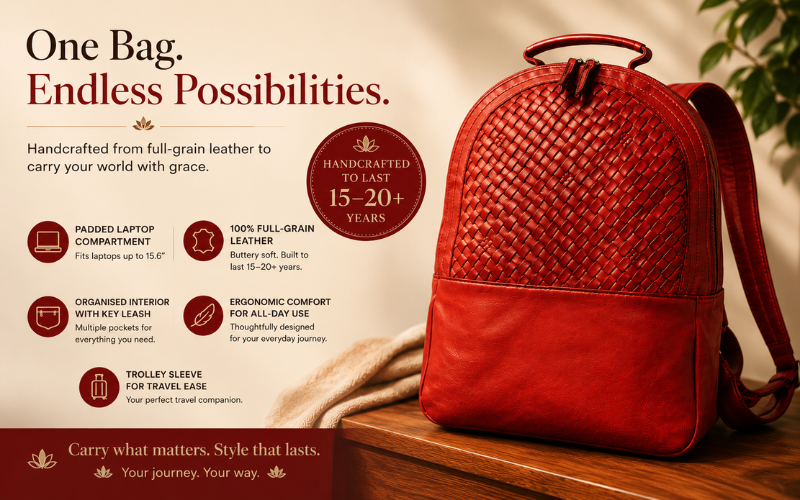
Rustic Town's leather backpack for work collection - full-grain leather, padded laptop sleeve, organised document compartments, handcrafted in Delhi from under $150.
What Are the Core Differences Between a Backpack and a Briefcase for Document Carry?
The differences between a backpack for documents and a briefcase are not just stylistic - they are structural, ergonomic, and functional. Understanding these differences explains why each format excels in specific contexts and fails in others.
How Does Each Format Handle the Physical Carry?
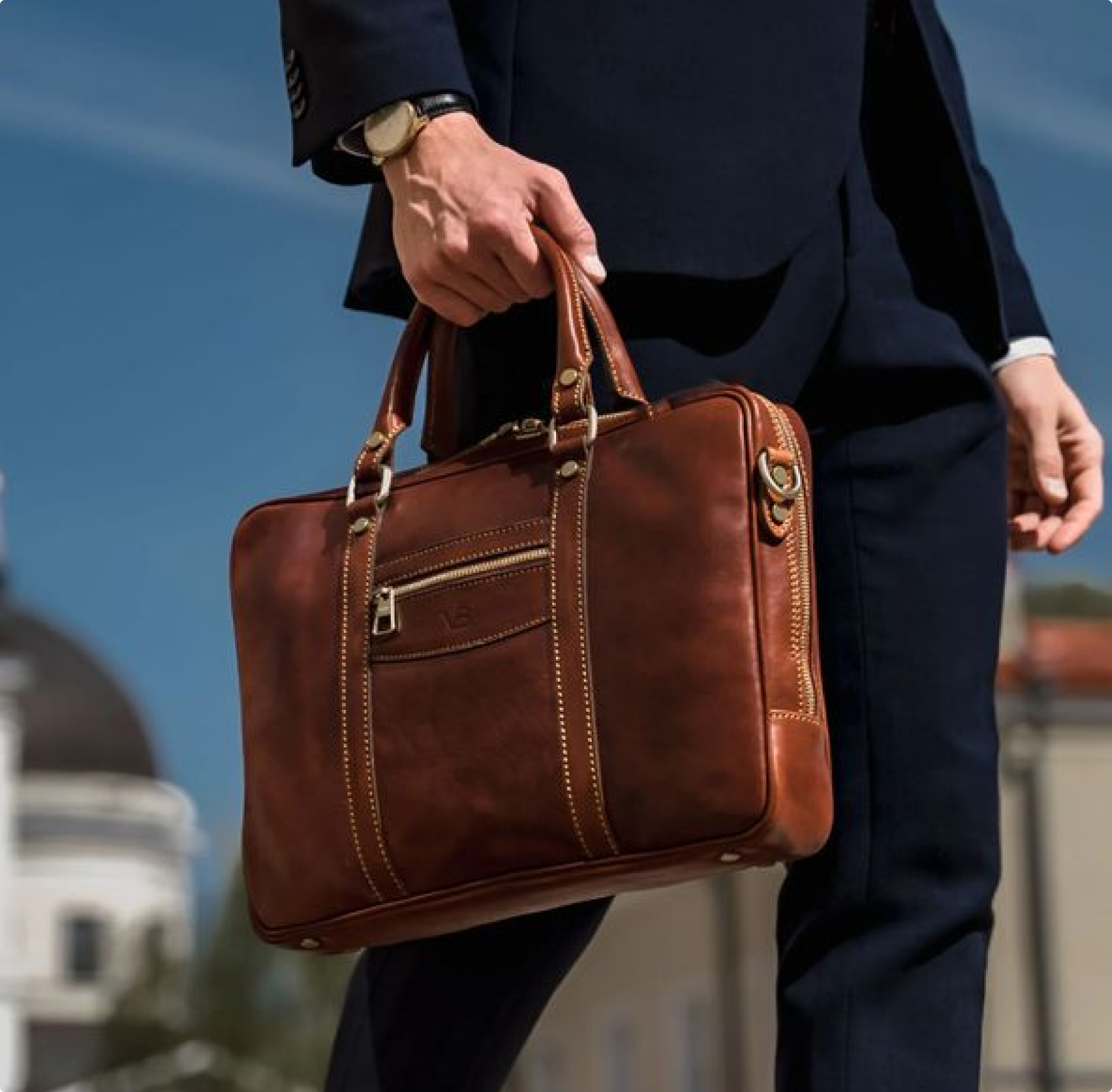
A briefcase is carried by a single top handle in one hand, or by a single shoulder strap on one shoulder. The full weight of the documents and contents rests on one arm or one shoulder for the duration of the carry. For short distances - the lobby to the car, the office to the meeting room - this is fine. For sustained carry of 15+ minutes with a heavy document load, the single-side weight distribution causes shoulder strain, postural imbalance, and arm fatigue that compound across the working week.
A leather backpack for work distributes the carry weight across both shoulders simultaneously, using the natural ergonomic capability of the human spine and shoulder structure to handle sustained loads without strain. A 5kg document and laptop load that becomes uncomfortable in a briefcase within 20 minutes of walking remains comfortable in a properly fitted backpack across an entire commute. The ergonomic difference is the most significant practical distinction between the two formats - and it grows more important as document loads get heavier.
How Does Each Format Handle the Documents Themselves?
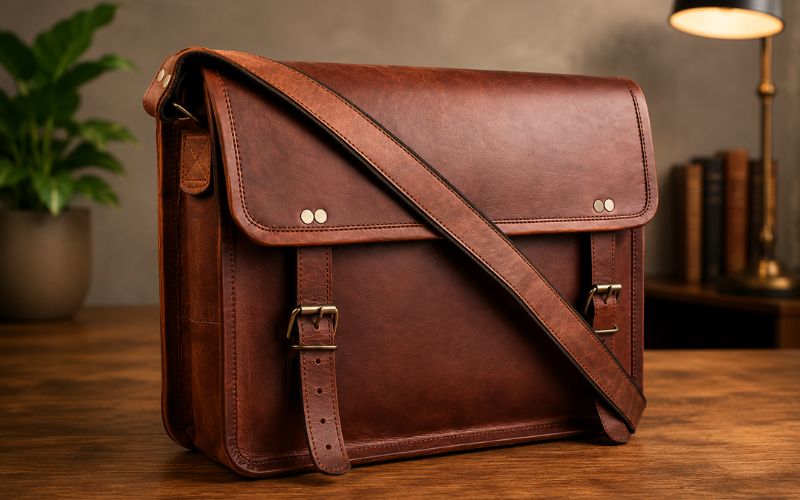
A briefcase is structurally designed for documents - flat horizontal interior, A4 or letter-sized in portrait orientation, hard or semi-hard sides that prevent document creasing, and traditional clasp closure that secures the contents. The geometry is purpose-built for professional document carry and has been refined for over a century. Documents inserted into a briefcase remain flat, organised, and protected throughout the carry.
A backpack for documents requires more deliberate design to handle documents well. Many backpacks have curved or rounded interior shapes that crease document edges, lack dedicated document compartments, or position the documents incorrectly relative to the laptop and other contents. A quality leather backpack for work addresses these issues with a flat document compartment positioned against the back panel, a separate laptop sleeve, and organisation that keeps documents from being crushed by other contents. Not every backpack is suitable for serious document carry - the ones that are have specific design features that make them work.
How Does Each Format Read in a Professional Context?
The professional signal of each format depends heavily on the specific industry and seniority context. In traditional law firms, finance institutions, executive boardrooms, and government contexts, a briefcase still reads as more formal and more senior than a backpack. In tech, consulting, creative industries, academia, and most modern corporate contexts, a quality leather backpack reads as equally professional - and often as more current and practical than a briefcase. The signal has shifted significantly over the past decade and continues to shift toward backpacks being acceptable in increasingly more professional contexts.
The leather and construction quality matter more than the format itself in modern contexts. A premium full-grain work document bag in either format reads as professional and considered. A cheap synthetic backpack reads as casual regardless of intent. A worn-out briefcase reads as outdated rather than traditional. The investment in quality matters more than the choice between formats.
|
Dimension |
Backpack |
Briefcase |
Winner for Document Carry |
Notes |
|
Daily carry comfort |
Excellent - both shoulders |
Limited - one arm/shoulder |
Backpack |
Major difference for 30+ min carry |
|
Document protection (flat) |
Good with proper design |
Excellent - purpose-built |
Briefcase |
Briefcase wins on geometry |
|
Laptop protection |
Excellent with padded sleeve |
Good with dedicated compartment |
Even |
Both can excel with right specs |
|
Capacity |
High - 15-25 litres standard |
Limited - typically 8-12 litres |
Backpack |
Backpack carries more |
|
Hands-free use |
Yes - both hands free |
No - one hand occupied |
Backpack |
Important for transit, calls, coffee |
|
Formality signal |
Modern professional |
Traditional formal |
Briefcase for highest formality |
Context-dependent |
|
Travel compatibility |
Excellent |
Limited |
Backpack |
Trolley sleeve, plane carry |
|
Weather resistance |
Good - back panel protects |
Variable |
Backpack |
Better against rain |
|
Aesthetic versatility |
Daily, travel, casual |
Formal contexts only |
Backpack |
Works in more contexts |
|
Long-term back health |
Good with proper fit |
Asymmetric load over time |
Backpack |
Significant for daily carriers |

When Is a Backpack the Better Choice for Work Documents?
A backpack for documents is the better choice in specific working contexts where the practical benefits outweigh the formality differential. Here are the contexts where the backpack consistently wins.
What Working Contexts Favour a Backpack?
Daily commutes longer than 20 minutes.
Any commute that involves more than 20 minutes of active carrying time - walking to the train, walking from the station to the office, climbing stairs, crossing city blocks - benefits significantly from a leather backpack for work. The two-shoulder weight distribution prevents the postural imbalance and shoulder strain that defines extended briefcase use. The longer the commute, the more dramatically the backpack wins on this dimension.
Public transport commuting.
Public transport - subway, bus, train - involves standing while holding or holding onto something, navigating crowded spaces, and frequent transitions. A backpack for documents keeps both hands free for stability, ticket scanning, phone use, and coffee. A briefcase requires one hand to be permanently occupied, making transit movement more cumbersome and tiring across the working week.
Heavy document loads.
When the daily document load includes multiple folders, a laptop, daily essentials, and weight that cumulates above 4kg, a backpack handles this load far better than a briefcase. The ergonomic advantage compounds with weight - a 2kg load is manageable in either format, but a 6kg load is genuinely uncomfortable in a briefcase and remains comfortable in a properly fitted backpack.
Modern corporate, tech, creative, and consulting environments.
In tech companies, consulting firms, creative agencies, marketing organisations, and most modern corporate environments, a quality leather backpack reads as professional, current, and practical. The traditional briefcase signal is less relevant in these contexts and may even read as overly formal or out-of-touch with modern working culture. A leather backpack for work matches the working register of these environments more naturally.
Travel-frequent professional roles.
Roles that involve frequent travel - consulting, sales, business development, project management - benefit from a backpack with trolley sleeve compatibility and travel-flexible capacity. A backpack handles the airport, hotel, client site, and home office across the working week more flexibly than a briefcase, which is purpose-built for office and meeting contexts but limited beyond them.
Younger and mid-career professionals.
Professionals under approximately 45-50 typically benefit from carrying a backpack rather than a briefcase. The signal differential between the two formats has shifted significantly for younger professional generations - a backpack reads as appropriate at all career levels in most modern contexts, while a briefcase increasingly reads as senior or specifically formal. For most working professionals, the backpack is the safer default with the more practical benefits.
When Is a Briefcase the Better Choice for Work Documents?
Despite the modern shift toward backpacks, there are specific contexts where a briefcase remains the better choice for professional document carry. Understanding these contexts prevents the mistake of carrying a backpack into an environment where it actively undermines professional credibility.
What Working Contexts Favour a Briefcase?
Traditional law firms and senior legal practice.
Senior partners and counsel in traditional law firms, particularly in litigation and corporate law contexts, still strongly favour briefcases. The professional environment maintains traditional formality signals, and the briefcase reads as appropriate at the senior level in ways a backpack does not. Junior lawyers may carry backpacks; senior partners typically do not in most jurisdictions.
Senior banking and finance executive contexts.
Investment banking, private banking, and senior finance executive contexts maintain the briefcase as the standard work document bag. Client meetings with high-net-worth clients, board meetings, and formal financial settings expect briefcase-level formality. A backpack in these contexts reads as junior or inappropriately casual.
Government and diplomatic contexts.
Government professionals - particularly senior diplomats, ministerial-level officials, and senior civil servants - carry briefcases as standard. The contexts (parliamentary chambers, formal government meetings, diplomatic events) maintain traditional formality. Backpacks are increasingly acceptable for junior government roles but not for senior ones in most jurisdictions.
Short-distance professional carry.
If your daily carry is genuinely short - the parking lot to the office, the office to the meeting room, the office building to a client building across the street - a briefcase serves perfectly well. The ergonomic limitations of one-shoulder carry only manifest over extended distance. For limited-distance carry, the formality signal of the briefcase exceeds the comfort benefit of a backpack.
Heavy client-facing meeting schedules.
If your typical day involves multiple back-to-back client meetings where the bag is carried into the meeting room, set on the conference table, opened to retrieve documents, and closed when departing - a briefcase handles this workflow more elegantly than a backpack. The briefcase opens flat for document access, sits naturally on a conference table, and projects the formal client-facing signal.
Senior-level positions in traditional industries.
C-suite roles in traditional industries (manufacturing, energy, traditional finance, traditional law, government) typically continue to use briefcases as appropriate to the seniority level. The signal of seniority and traditional professionalism that a briefcase carries remains relevant in these contexts even as it becomes less relevant in newer industries.
|
Working Context |
Best Choice |
Why |
Acceptable Alternative |
|
Modern tech / SaaS |
Backpack |
Professional, practical, matches culture |
Messenger bag |
|
Consulting (most levels) |
Backpack |
Travel-friendly, professional, current |
Tote (women), briefcase (most senior) |
|
Senior law (partner level) |
Briefcase |
Traditional formality, senior signal |
No real alternative in most firms |
|
Junior law |
Backpack |
Practical for long days, document carry |
Briefcase if firm culture demands |
|
Investment banking (senior) |
Briefcase |
Client formality, traditional signal |
Limited acceptable alternatives |
|
Investment banking (junior) |
Either |
Depends on specific firm and team |
Backpack increasingly common |
|
Senior government |
Briefcase |
Traditional formality required |
Limited alternatives |
|
Creative agency |
Backpack |
Casual professional, practical |
Messenger, satchel |
|
Academic |
Backpack |
Document and book load, transit |
Tote bag (some traditions) |
|
Healthcare admin |
Backpack |
Practical, document-friendly |
Tote, briefcase |
|
Consulting client site |
Backpack with trolley sleeve |
Travel + work duality |
Briefcase if highly formal |
|
Field sales |
Backpack |
Hands-free, mobile |
Messenger |

Rustic Town's backpack for documents range - structured interiors, padded laptop sleeves, document-friendly geometry, full-grain leather construction.
What Should You Look for in a Backpack for Work Documents?
Not every backpack handles documents well. The category includes many backpacks designed for school, travel, or general use that are inadequate for serious professional document carry. A quality leather backpack for work has specific features that make it suitable for documents.
What Are the Critical Features for a Document-Carry Backpack?
A flat document compartment positioned against the back panel.
The most important feature for document carry is a flat compartment that holds A4 or letter-size documents in their natural portrait orientation without bending or curving. This compartment should be positioned against the back panel of the backpack - the flattest part of the bag - rather than in the curved main compartment where documents inevitably get crushed.
Separate laptop and document compartments.
A document compartment that is separate from the laptop sleeve prevents the documents from being crushed when the laptop is accessed and prevents the laptop from being scratched by sharp document edges. A backpack for documents should have these as two distinct compartments, not as a shared space.
Structured top and sides that maintain shape.
A leather backpack for work with structured construction maintains its shape whether empty or fully loaded. Slouchy unstructured backpacks crease documents at the corners and prevent the documents from sitting flat. Structure is what makes a backpack suitable for documents - and what distinguishes a serious work document bag from a casual carry alternative.
Quality zip closures on all compartments.
Documents need to be secure during transit - protected from rain exposure, accidental opening, and unauthorised access. Quality zip closures on the document compartment and main compartment are non-negotiable for serious document carry. Magnetic flap closures alone (without zips) are inadequate for valuable documents.
Reinforced shoulder straps for sustained loaded carry.
A full grain leather backpack carrying documents and a laptop typically loads to 4-7kg. The shoulder straps need reinforced attachment, padding for shoulder comfort, and quality strap material that does not stretch under load. Cheap straps fail under sustained loaded carry, regardless of how the rest of the bag is constructed.
A trolley sleeve for travel use.
If the backpack is used for any business travel, a pass-through sleeve on the back that fits over a roller suitcase handle is essential. The sleeve allows the backpack to ride on the suitcase through airports rather than requiring shoulder carry the entire journey - critical for travel-frequent professional roles.
Full-grain leather construction throughout.
For a backpack for documents used in professional contexts, full-grain leather is the only grade that delivers the longevity, professional signal, and dignity worth investing in. Bonded leather and PU alternatives deteriorate within 2-3 years and read as less professional. A full-grain backpack lasts 15-20+ years and develops increasingly distinguished patina.
|
Feature |
Why It Matters for Document Carry |
Importance |
What Failure Looks Like |
|
Flat document compartment |
Documents stay flat, uncreased |
Critical |
Curved interior creases corners over time |
|
Separate laptop sleeve |
Prevents crushing and scratching |
Critical |
Shared space damages both |
|
Structured construction |
Maintains shape under load |
Very important |
Slouchy backpack crushes contents |
|
Quality zip closures |
Document security and weather protection |
Critical |
Open compartments expose contents |
|
Reinforced shoulder straps |
Comfort under sustained load |
Very important |
Cheap straps stretch and fail |
|
Padded back panel |
Comfort and document protection |
Important |
Hard contents press against back |
|
Trolley sleeve |
Travel functionality |
Critical for travel |
No travel sleeve limits use |
|
Full-grain leather |
Longevity and professional signal |
Very important |
Cheap leather fails within years |
See Rustic Town's work document bag specifications - all backpacks built with structured document compartments and full-grain leather construction.
How to Choose Between a Backpack and Briefcase: A Decision Framework
Here is the step-by-step framework for making the backpack vs briefcase decision based on your actual working context rather than outdated assumptions.
Step 1. Calculate your average daily carry time honestly.
How many minutes per day do you actually carry your work bag actively? Add your morning commute walking time, intra-day transit between meetings, and evening commute. If the total exceeds 30 minutes daily, a leather backpack for work is significantly better for your back and shoulders. Under 30 minutes total daily carry, either format works ergonomically.
Step 2. Assess your typical daily load weight.
Weigh your typical daily work load: laptop (1-2kg), charger (0.3kg), documents (0.5-2kg depending on volume), daily essentials (0.5-1kg), water bottle and lunch (1-2kg). Total typical daily load is usually 4-6kg for office workers, more for document-heavy roles. Above 5kg, a backpack is significantly more comfortable. Below 3kg, either format works.
Step 3. Define your professional environment's formality level.
Honestly categorise your working environment: traditional formal (senior law, finance, government), modern professional (tech, consulting, modern corporate), or casual professional (creative, startup, academic). Traditional formal favours briefcase. Modern professional accepts both. Casual professional favours backpack.
Step 4. Consider your seniority level and visibility.
Senior client-facing roles in traditional industries (partner-level law, senior finance) may still need a briefcase for top-level client meetings even if a backpack works for daily commute. Junior to mid-career roles in any industry typically benefit from a backpack. C-suite in traditional industries may favour briefcase; C-suite in modern industries often carries quality backpacks.
Step 5. Identify your travel frequency.
If you travel for work even occasionally - monthly trips, quarterly conferences, occasional client visits - a backpack with trolley sleeve compatibility is significantly more practical than a briefcase. The backpack handles airports, hotels, and travel logistics in ways a briefcase cannot. For travel-frequent roles, a backpack is almost always the right choice.
Step 6. Evaluate the document handling requirements specifically.
If your role involves daily handling of important physical documents - contracts, court papers, client files - the document handling specifications matter. A briefcase has the geometry advantage. A quality backpack for documents with proper structured construction matches it. Either can work; ensure the specific bag you choose handles documents well regardless of format.
Step 7. Consider the long-term ergonomic implications.
Briefcase carry with sustained loaded use over years contributes to asymmetric postural development, shoulder imbalances, and back issues for many carriers. If you anticipate carrying the same way for 10+ years, the back-friendly nature of a backpack is a non-trivial health consideration. Many former briefcase carriers switch to backpacks specifically for this reason after years of one-shoulder strain.
Step 8. Consider the both-bags solution.
Many serious professionals own both a quality leather backpack for daily commute and a quality leather briefcase for high-formality client meetings. This is not extravagance - it is the appropriate response to genuine context variation. Use the backpack for the 80% of working time that involves commute, travel, and standard meetings. Use the briefcase for the 20% of working time that demands maximum formality. Both bags last 15-20 years; the cumulative investment is reasonable for the quality of life and professional signal it provides.
How Has the Backpack vs Briefcase Conversation Changed Recently?
The professional carry landscape has shifted significantly over the past 10-15 years. Understanding these shifts explains why the answer to backpack vs briefcase is different now than it was a generation ago - and likely different again from where it will be a decade from now.
What Has Changed in Professional Carry Expectations?
Tech industry leadership normalised quality leather backpacks at executive levels. Senior leaders at major tech companies began carrying high-end leather backpacks rather than briefcases starting in the early 2010s, and this normalised the format at executive levels in adjacent industries. The signal that a backpack is junior or non-executive became less true with each year that senior tech leaders modelled the alternative.
Travel-heavy consulting roles drove backpack adoption in management consulting. Major consulting firms - traditionally briefcase-strong - shifted toward leather backpacks as travel demands made the practical advantages obvious. Consultants travelling 4 days per week needed travel-compatible carry, and quality leather backpacks delivered this in ways briefcases could not.
Pandemic and hybrid work patterns accelerated the trend. The shift to hybrid work increased the practical importance of bags that travel between home and office, between client sites, and between professional contexts and casual ones. A backpack handles this versatility naturally; a briefcase struggles with the casual dimensions of hybrid working life.
Where Is the Professional Carry Conversation Heading?
The trend toward backpack acceptance is likely to continue. Each working generation has been more accepting of backpacks at higher seniority levels than the previous generation. Industries that maintain briefcase formality (senior law, traditional finance, senior government) are the slowest to shift - but even these contexts increasingly accept backpacks at senior levels in many jurisdictions. The briefcase will likely remain present in specific traditional contexts but is unlikely to return to its former universal status.
Quality is the relevant differentiator more than format. A premium full-grain leather backpack for work is now widely considered as professional as a premium leather briefcase. The choice between formats is increasingly about practicality, ergonomics, and personal preference rather than about which format is appropriate for which level of professional seriousness.
Browse Rustic Town's full grain leather backpack collection - the modern professional carry that works across traditional and contemporary working environments.
Frequently Asked Questions: Backpack vs Briefcase for Work Documents
Q: Is a backpack acceptable for professional work?
A: Yes, in most modern professional environments. Tech, consulting, creative industries, modern corporate, healthcare administration, and academic contexts all accept quality leather backpacks at all seniority levels. Traditional formal contexts - senior law firms, senior finance, senior government - may still favour briefcases. Junior to mid-career roles in any industry typically benefit from a backpack.
Q: Which is better for back health - backpack or briefcase?
A: Backpack is significantly better for sustained back health. The two-shoulder weight distribution prevents the asymmetric loading that briefcase carry creates over years. Sustained briefcase carry contributes to shoulder imbalances, postural issues, and back problems for many long-term users. For daily document carriers, the backpack is the back-friendly choice.
Q: Can a leather backpack hold A4 or letter-size documents flat?
A: Yes - quality leather backpacks designed for work include flat document compartments positioned against the back panel that hold A4 or letter-size documents in portrait orientation without bending. Not all backpacks have this; verify the document compartment specification before buying. Generic backpacks without dedicated document compartments crease documents over time.
Q: Do briefcases still work for daily document carry?
A: Briefcases work well for daily document carry in specific contexts: short distance daily carry (under 20 minutes), highly formal professional environments, senior roles in traditional industries, and document-focused work where the briefcase's flat geometry is ideal. They work less well for long-distance commuting, heavy loads, and travel-frequent roles - where backpacks are more practical.
Q: What size backpack is right for documents and a laptop?
A: 18-25 litres is the right capacity for documents, a laptop, and daily essentials. Below 15 litres limits document and laptop capacity. Above 28 litres becomes oversized for typical daily use. Look for a flat document compartment, separate laptop sleeve, and structured construction in this capacity range.
Q: How much do quality leather backpacks for documents cost?
A: Quality full-grain leather backpacks for professional document carry typically range from $130 to $300 for standard sizes. Premium designer options run higher. The investment is justified by 15-20 year lifespan - a $150 quality backpack used for 15 years costs $10 per year of professional use, significantly less than replacing cheaper backpacks every 2-3 years.
Q: Should you have both a backpack and a briefcase?
A: Yes for many professionals. The both-bags solution uses a quality leather backpack for the 80% of working time involving commute, travel, and standard meetings, and a quality leather briefcase for the 20% involving high-formality client meetings, board presentations, or traditional senior contexts. Both bags last 15-20 years; the combined investment is reasonable.
Q: What is the most important feature in a work document backpack?
A: A flat document compartment positioned against the back panel that holds A4 or letter-size documents in portrait orientation without crushing. This single specification distinguishes a real backpack for documents from a generic backpack. Combined with a separate padded laptop sleeve and full-grain leather construction, this creates the foundation of a professional document carry backpack.
The Short Answer: Is a Backpack or Briefcase Better for Work Documents?
The honest answer to backpack vs briefcase depends on your specific working context - not on outdated assumptions about which format is more professional. A leather backpack for work is the better choice for sustained daily commutes (over 20 minutes), heavy document loads (over 5kg), modern professional environments, travel-frequent roles, and most professionals under senior partner level in traditional industries. A briefcase remains the better choice for traditional formal environments (senior law, senior finance, senior government), short-distance professional carry, document-focused workflows, and senior roles in traditional industries.
For most working professionals, a quality backpack for documents in full-grain leather with a flat document compartment, separate laptop sleeve, and structured construction is the practical winner across the working week. The ergonomic benefits, capacity advantages, and travel flexibility outweigh the formality differential in most modern professional contexts. A backpack is the modern professional standard for daily document carry.
If your working life crosses both traditional formal and modern professional contexts, owning both a quality full grain leather backpack for daily use and a quality leather briefcase for high-formality occasions delivers the appropriate carry for each context.
The investment in both bags lasts 15-20 years, costs reasonable per year, and resolves the format choice question by giving you the right answer for every working context rather than forcing one format to serve every situation.