


Leather Duffle vs. Duffel: The Spelling Debate Nobody Asked For (But Everyone Searches)
You typed "leather duffle bag" into Google. Then you wondered if you spelled it wrong. So you tried "leather duffel bag" instead. Now you're reading an article about spelling instead of buying a bag.
Welcome. You're not alone. This particular spelling confusion sends millions of shoppers down rabbit holes every year. And here's the twist — both spellings are technically correct, but each has a different story to tell.
What started as a practical question about leather duffle bags has accidentally become a linguistic adventure. We're going to settle this debate once and for all, then get you back to what actually matters — finding the right bag.
Along the way, you'll learn something genuinely interesting about a Belgian town, World War II soldiers, and why English spelling is fundamentally absurd.
Let's sort this out.
The Great Spelling Mystery: Where Did These Words Come From?
Every word has an origin story. This one involves a small town in Belgium that accidentally named a global product category.
Duffel — spelled with an "e" — is a town in the Antwerp province of Belgium. Population around 23,000. Unremarkable in most ways except one: centuries ago, it produced a thick, coarse woolen cloth that became famous throughout Europe.
This "duffel cloth" was heavy, durable, and weather-resistant. Perfect for outdoor use. Sailors, soldiers, and travelers loved it. When someone eventually stitched this cloth into a cylindrical bag with a drawstring closure, the name followed naturally. A bag made from duffel cloth became a duffel bag.
So technically, "duffel" with an "e" is the original, historically accurate spelling. It references the actual place that invented the material.
But language doesn't care about technical accuracy. It cares about how people actually use words. And people, being people, started spelling it differently.

How "Duffle" Happened: The American Simplification
Americans have a long tradition of simplifying British spellings. Color instead of colour. Favor instead of favour. Center instead of centre. It's not laziness — it's a deliberate linguistic independence that traces back to Noah Webster and early American identity formation.
"Duffle" emerged as an American variant, dropping the "e" for no particularly good reason other than it felt right to enough people. The pronunciation stayed identical. The meaning stayed identical. Only the spelling shifted.
World War II accelerated both spellings into common usage. Military duffle bag leather and canvas versions became standard issue for American soldiers. These bags — simple, cylindrical, rugged — carried everything a soldier owned. Millions of young men returned home familiar with the duffle bag concept, and they spelled it however felt natural.
Post-war, both spellings coexisted peacefully. Dictionaries accepted both. Manufacturers used both. Nobody particularly cared because everyone understood what you meant either way.
Then the internet happened, and suddenly spelling affected whether you found what you were looking for.

The SEO Reality: Why Spelling Actually Matters Now
Here's where this gets practical for anyone shopping for a leather duffle bag.
Search engines have become remarkably sophisticated, but they still treat different spellings as potentially different queries. Google usually understands that "duffle" and "duffel" mean the same thing and shows similar results. Usually. Not always.
Some retailers optimize their websites for "duffel" because it's technically correct. Others optimize for "duffle" because more Americans search that way. A few smart ones — like us — optimize for both because we'd rather you find a great bag than win a spelling bee.
The search volume data is interesting. In the United States, "duffle bag" and "duffel bag" run nearly neck-and-neck in search popularity. "Duffle" edges ahead slightly in casual consumer searches, while "duffel" appears more often in formal product descriptions and journalistic writing.
What does this mean for you? Search both ways if you're not finding what you want. A leather travel duffle might be hiding under the "duffel" spelling, and vice versa. The bag doesn't care how you spell its name.

Okay, But Which Spelling Should I Use?
Both. Neither. Whichever feels right to you.
If you're writing formally — a newspaper article, an academic paper, a product description for a major retailer — "duffel" with the "e" is safer. It's the spelling most style guides prefer, and it honors the Belgian origin.
If you're texting a friend, posting on social media, or just searching for a bag to buy, "duffle" works perfectly fine. Nobody will correct you. And if they do, they need better hobbies.
The English language is full of these accepted variations. It's theatre or theater. Grey or gray. Judgement or judgment. Language evolves through usage, not decree. Both spellings of leather duffle have earned their place through decades of common use.
Now that we've thoroughly settled what didn't really need settling, let's talk about what you actually came here for.
What Makes a Leather Duffle Worth Buying
Spelling aside, you're here because you want a bag. Specifically, you want a leather duffle bag that justifies the investment over cheaper alternatives. Let's talk about what separates the exceptional from the forgettable.
The Leather Question
Full grain leather remains the gold standard. It's the complete, unaltered surface of the hide — strongest, most durable, and capable of developing that coveted patina over years of use. Top grain leather works too, though it sacrifices some character for uniformity.
Avoid anything labeled simply "genuine leather" — counterintuitively, this indicates lower quality in the leather hierarchy. And bonded leather? That's ground-up scraps mixed with synthetics. Walk away.
A quality mens leather duffle should smell like leather — rich, earthy, natural. Chemical or plastic odors signal heavy processing or synthetic components. Your nose knows.
Construction Details That Matter
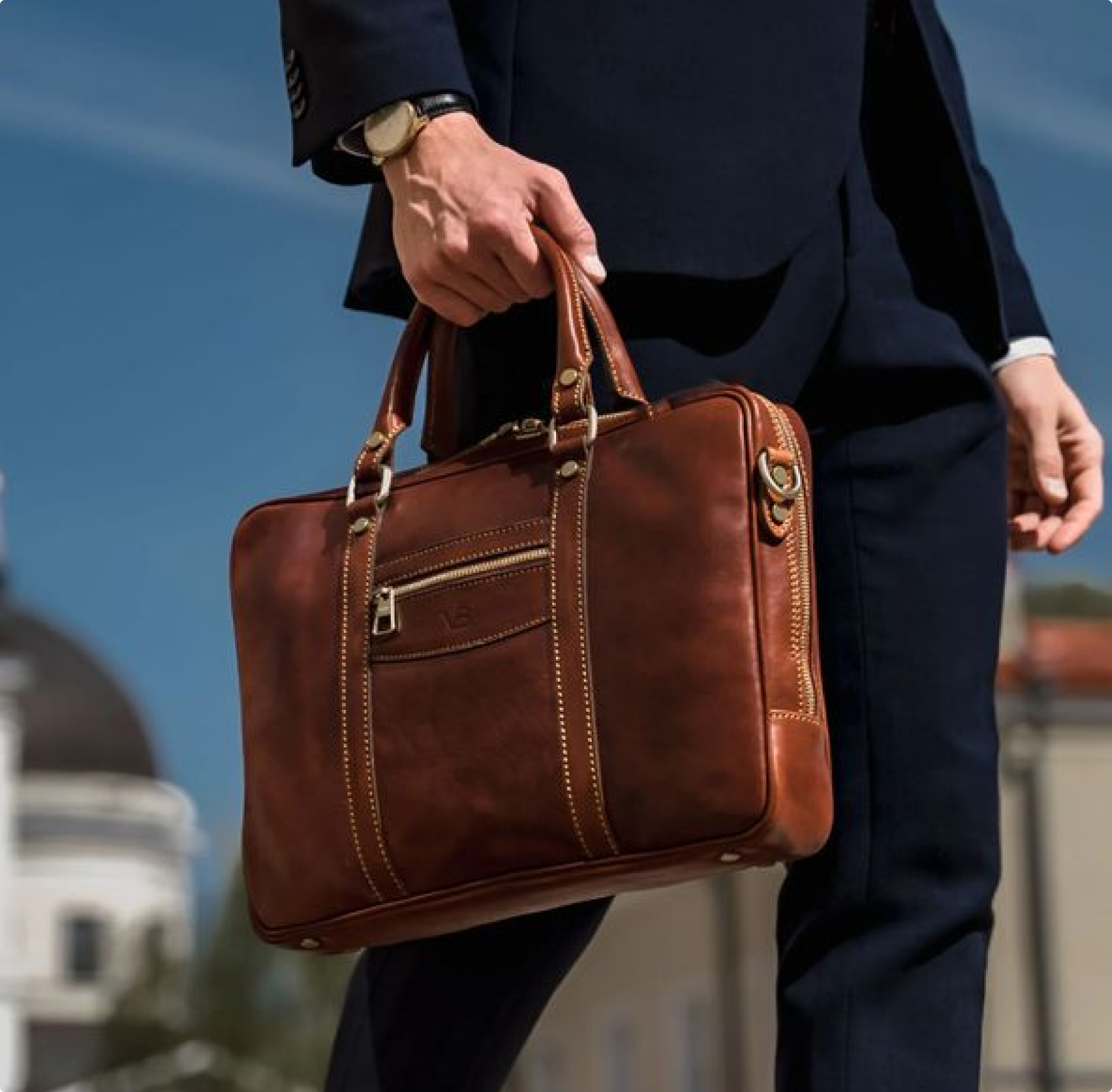
Stitching tells the story of craftsmanship. Look for double-stitched seams with waxed thread, evenly spaced and slightly recessed into the leather. Loose threads, inconsistent spacing, or single-thread construction predict early failure.
Hardware deserves attention too. Solid brass or quality metal zippers, buckles, and clasps outlast plated alternatives by decades. Test zippers before buying — they should glide smoothly without catching. A stuck zipper on day one becomes a broken zipper by month six.
Handles make or break daily usability. Rolled leather handles with adequate diameter prevent palm fatigue during carrying. Flat, thin handles cut into your hand under load. And wherever handles attach to the bag body, reinforcement rivets should supplement stitching.

Size for Your Reality
A duffle bag for travel should match how you actually travel, not how you imagine traveling. Weekend warriors need different capacity than business travelers or gym enthusiasts.
For overnight and gym use, 18-20 inches handles the job without excess bulk. Weekend trips call for 20-22 inches — enough for three to four days while staying carry-on compliant. Extended travel demands 22-24 inches, though be prepared for weight when fully packed.
Err toward smaller if uncertain. A slightly underpacked bag travels easier than an overstuffed one. And honestly, most of us pack things we never use anyway.
The Versatility Argument: Why Leather Duffles Endure
Trends come and go in luggage. Hard-shell suitcases. Ultralight backpacks. Smart luggage with built-in chargers. Each generation brings new "innovations" that feel essential until they don't.
The leather duffle has outlasted them all. Not because it's technologically superior — it isn't. But because it solves the fundamental problem of carrying things in a way that never becomes obsolete.
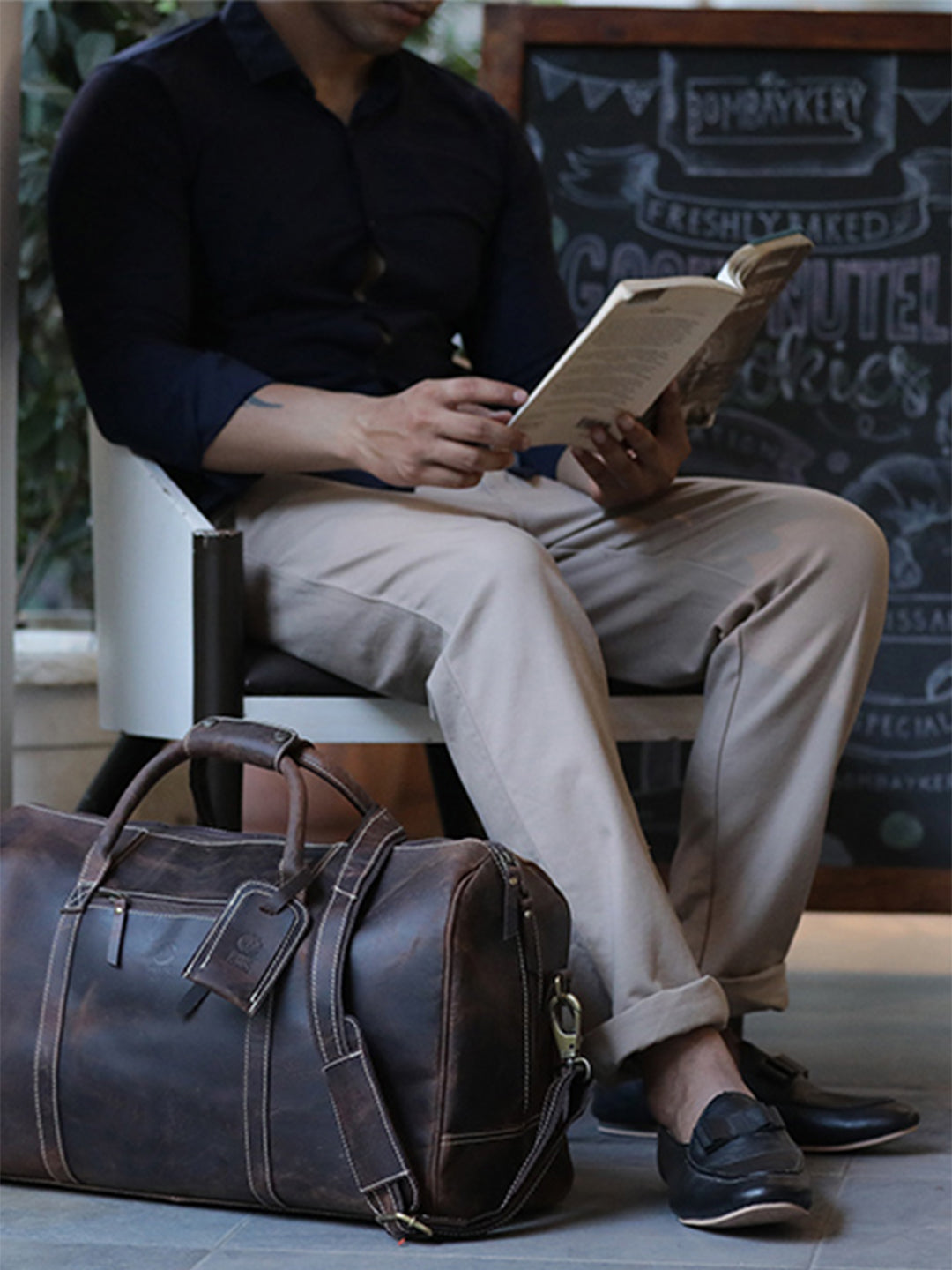
A leather duffle works for the gym. It works for a weekend away. It works for a business trip when you want to project competence without screaming "corporate drone." It works thrown in a car trunk or carried through an airport or stashed under a bus seat.
More importantly, it works across decades. The bag you buy today still looks appropriate — better, actually — twenty years from now. Can't say that about the smart suitcase with the app that stopped updating in 2019.
At Rustic Town, we've watched our bags evolve with their owners. The leather duffle bag someone bought for business trips becomes their weekend escape bag, then their gym companion, then the bag they grab for anything important. Versatility isn't a feature — it's the entire point.
Common Mistakes First-Time Buyers Make
Learning from others' regrets saves you from creating your own. Here's what trips up most first-time leather travel duffle buyers.
Prioritizing Price Over Quality
A $60 "leather" duffle isn't a bargain — it's a delayed expense. Cheap bags fail at stress points within two years. Zippers jam. Handles tear. Stitching unravels. You buy another bag, then another. The math never works in favor of cheap.
Budget $150-300 for a bag worth owning. That sounds like a lot until you realize it's the last bag purchase you'll make for decades.
Ignoring Weight Empty
Leather has weight. Quality leather has more weight. That mens leather duffle that feels substantial and reassuring in the store becomes a shoulder-destroyer when packed with a week's clothing.
Know your physical limits. If you struggle with heavy bags, consider a smaller size or look for bags with well-designed shoulder straps that distribute weight effectively.
Choosing Trendy Over Timeless
That unusual color or trendy hardware looks exciting now. In three years, it looks dated. In ten years, embarrassing. Classic brown, tan, and black exist because they work with everything and age gracefully.
Save personality expression for items you'll replace regularly. Your duffle should be a neutral foundation that supports whatever style you're currently into.
Overlooking the Shoulder Strap
Many buyers focus entirely on the bag body and treat the shoulder strap as an afterthought. Big mistake. A quality adjustable strap with adequate padding transforms your carrying experience.
Check strap attachment points for reinforcement. Test the adjusters for smooth operation. Consider whether the strap is detachable for situations where hand-carry works better.
The Patina Promise: Why Your Bag Gets Better
Here's the magic that separates leather duffle bags from every other option: they improve with age.
New leather looks good. Aged leather looks magnificent. The process — called patina development — happens naturally through use. Sunlight deepens color. Natural oils from your hands condition and polish high-contact areas. Minor scratches blend into the surface, adding character rather than damage.
A duffle bag leather surface after five years of regular use develops a richness that can't be manufactured. It's visual proof of adventures taken, places visited, life lived. Every mark tells a story you actually remember.
Compare this to synthetic alternatives that simply degrade. Nylon fades. Polyester pills. Plastic cracks. These materials don't age — they just get worse until you throw them away.
Investing in leather means investing in a future where your bag looks better on your hundredth trip than it did on your first.
Care Without Obsession
Quality leather doesn't require elaborate maintenance rituals. A minimalist approach works best.
Clean occasionally with a damp cloth to remove surface dirt. Condition two to three times per year with a quality leather conditioner to keep fibers supple. Store stuffed with paper or cloth to maintain shape, in a breathable dust bag away from direct sunlight.
That's it. No weekly treatments. No special storage systems. No anxiety about every scratch or scuff. The leather knows what it's doing — your job is mostly to not interfere.
Water exposure isn't catastrophic. If your bag gets wet, let it dry naturally at room temperature — never with heat — then condition afterward. Full grain leather handles moisture better than most people expect.
The Final Word on Spelling (And Bags)
So here we are. You now know more about the duffle/duffel spelling situation than anyone reasonably needs to know. You've learned about Belgian textile history, American linguistic independence, and the arbitrary nature of English orthography.
More usefully, you know what makes a leather duffle bag worth buying. Full grain leather. Quality construction. Appropriate size. Classic color. These fundamentals matter infinitely more than how you spell the name.
Whether you search for "leather duffle" or "leather duffel," you deserve to find something exceptional. A bag that handles your travels gracefully, ages beautifully, and outlasts the spelling debates of future generations.
At Rustic Town, we spell it both ways because we care more about connecting you with quality than winning linguistic arguments. Our leather duffle bags — or duffel bags, your choice — are crafted from full grain leather with the kind of attention that makes spelling irrelevant.
The bag doesn't care how you found it. It just cares about the journeys ahead.
Now stop reading about spelling and go find your bag. However you spell it.