


Messenger Bag vs Briefcase: Which Is Better for Work?
Quick Answer: A messenger bag is better for most modern workplaces - it carries hands-free, suits business-casual dress, and handles commutes well. A briefcase is better for formal, suit-and-tie environments where structure matters. For roughly 8 in 10 professionals, the messenger bag is the more practical choice.
A messenger bag is a soft, crossbody work bag with a flap closure and a laptop compartment; a briefcase is a structured, top-handle case built for documents and formality. Both carry a laptop and your daily essentials - the difference is how they carry, and what they signal in the room.
This guide compares the two honestly, with real prices and sizes from Rustic Town's range, so you can decide in five minutes instead of fifty browser tabs.
What Is the Difference Between a Messenger Bag and a Briefcase?
The core difference is structure and carry style. A messenger bag hangs crossbody on an adjustable strap, sits soft against the body, and opens with a fold-over flap you can reach without putting the bag down. A briefcase is carried by a top handle (often with a removable shoulder strap), holds a rigid rectangular shape, and opens flat like a case.
Here is the full side-by-side:
| Factor | Messenger Bag | Briefcase |
|---|---|---|
| Carry style | Crossbody, hands-free | Top handle, in-hand |
| Structure | Soft, flexible | Rigid, holds shape |
| Formality | Casual to business-casual | Business-formal |
| Laptop fit | 11-16 inch, padded sleeve | 13-15 inch, structured slot |
| Commute (bike, train, walk) | Excellent | Awkward on a bike |
| Access on the move | Flap opens while worn | Must stop and set down |
| Document handling | Fine for folders | Best - keeps papers crisp |
| Weight when empty | Lighter (soft construction) | Heavier (frame and structure) |
| Versatility (work + weekend) | High | Low - looks formal everywhere |
| Rustic Town price range | $39.99 - $99.45 | $99.99 |

Where Did the Messenger Bag Come From, and Why Does It Suit Modern Work?
The messenger bag predates the briefcase as a working tool. Pony Express riders and 19th-century postal couriers wore crossbody satchels because they needed both hands free and instant access to their cargo - the same two problems every commuter solves today on a train platform with a coffee in one hand. Bicycle messengers in New York and London adopted the design in the 20th century for the same reason, and when laptops shrank enough to carry daily, bag makers simply added a padded sleeve to a silhouette that had already proven itself for a hundred years.
The briefcase took the opposite route: it descended from the lawyer's document case, built to keep papers flat and project authority. That heritage is exactly why it still reads as formal - and why it feels out of place at a standing desk or on a cycle lane. The short version: the messenger bag was designed for movement, the briefcase for arrival. Most modern work is movement.
When Is a Messenger Bag the Better Choice?
Choose a messenger bag if any of these describe your week: you commute by train, bike, or on foot; your office dress code is business-casual or relaxed; you pull your laptop out multiple times a day; or you travel light for overnight work trips and want one bag that does double duty.
The crossbody strap is the practical win. Your hands stay free for coffee, a phone, and a train handrail, and the weight sits across your torso rather than in one clenched fist. There is an access advantage too: at airport security, in a lift, at a client's reception desk, the flap opens while the bag is still on your shoulder. A briefcase makes you find a flat surface first.
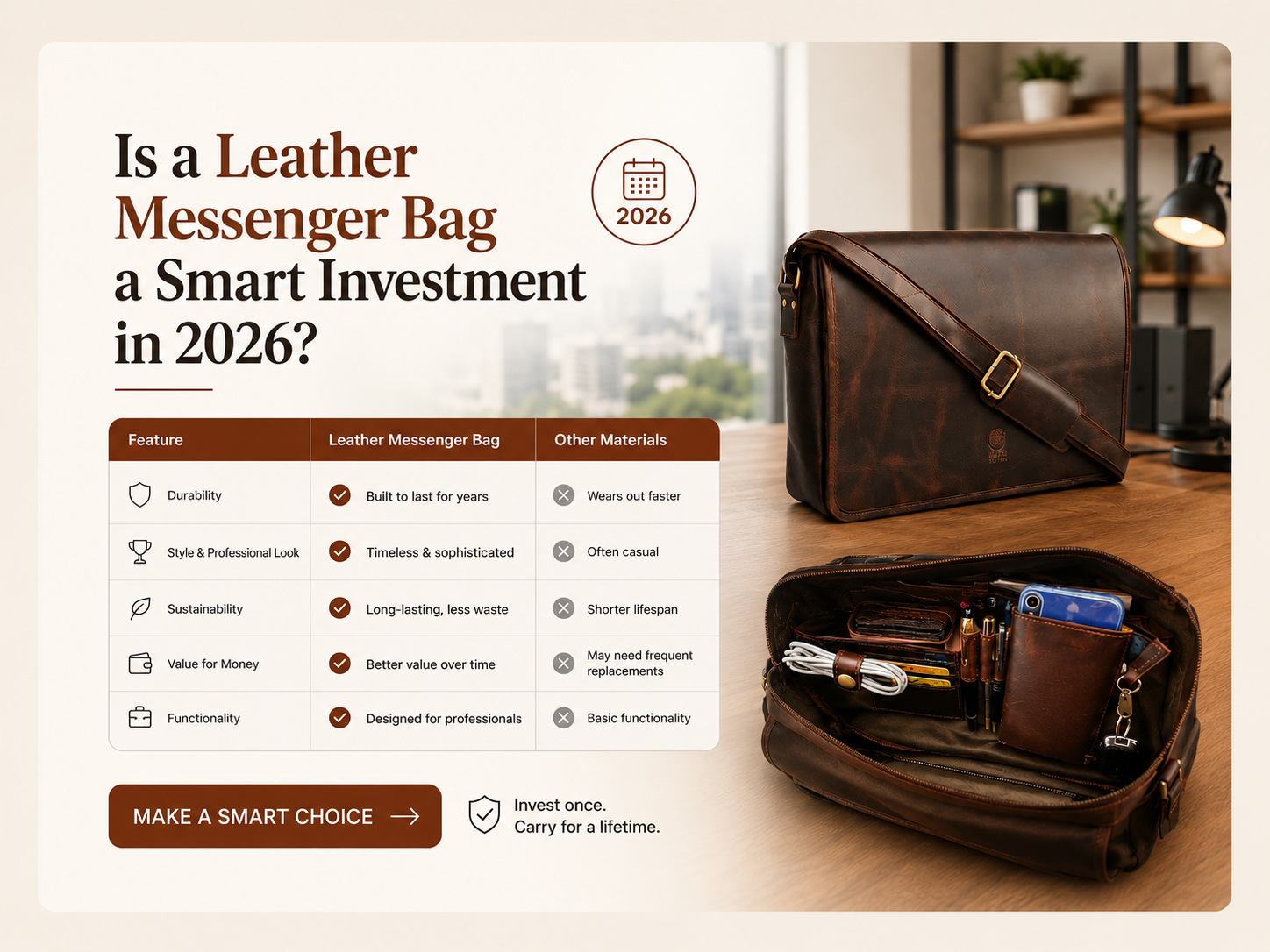
Full-grain leather adds a third advantage: unlike nylon commuter bags, it sharpens with age. The surface darkens and burnishes into a patina, so the same bag works in a client meeting at year five better than it did at week one. Rustic Town's leather messenger bags run from $39.99 for an 11 inch tablet size to $99.45 for the 16 inch Ranger Buffalo - the full-grain buffalo leather flagship that fits a large laptop, chargers, and a document folder with room left over.

When Is a Briefcase the Better Choice?
Choose a briefcase if your environment is formal - law, finance, client-facing consulting - and the bag itself is part of the dress code. A structured case keeps documents crisp and unfolded, presents cleanly when set on a boardroom table, and reads as deliberate in a way a slouchy bag never will. If your week includes courtrooms, signing ceremonies, or boardrooms where everyone else carries structure, match the room.
The trade-off is convenience. A briefcase occupies a hand, swings on stairs, and is genuinely awkward on a bicycle. It is also the less versatile purchase: a briefcase at a weekend market looks like you got lost on the way to a deposition.
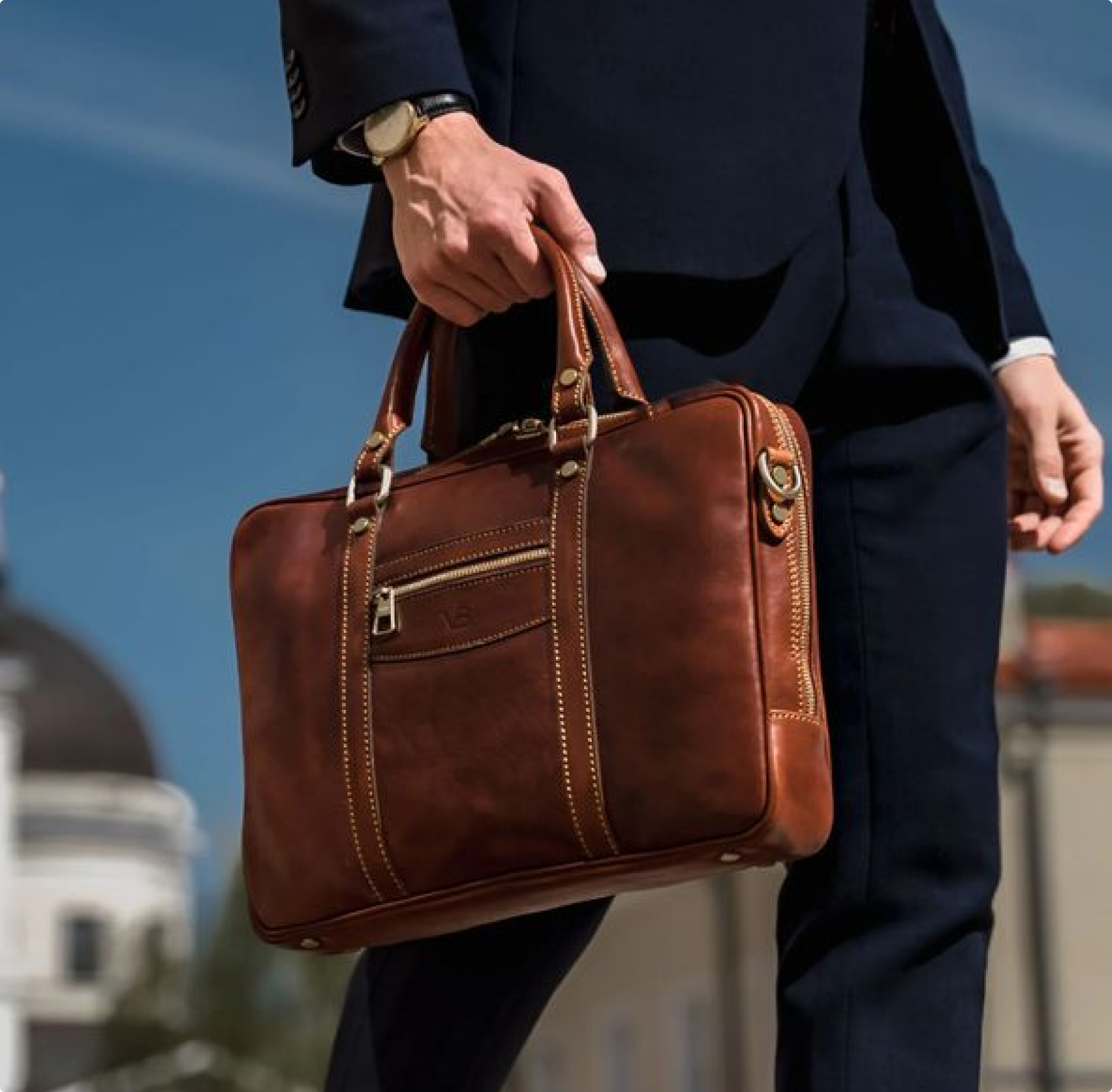
Hybrid designs solve most of this. Rustic Town's Roamer ($99.99) is a leather briefcase with a detachable shoulder strap, so it carries as a structured case into the meeting and as a crossbody on the commute. That hybrid is the honest answer for most people who think they need a traditional briefcase.
Which Bag Suits Your Dress Code?
The fastest way to choose is to match the bag to what you actually wear on a normal Tuesday:
| Your dress code | Best choice | Colour advice |
|---|---|---|
| T-shirt / hoodie, startup or creative | Messenger bag, any size | Tan or brown for contrast |
| Business casual (chinos, open collar) | Messenger bag, 14-16" | Brown leather, brass hardware |
| Suit, no tie | Messenger bag or hybrid briefcase | Dark brown or black |
| Suit and tie, formal industry | Briefcase (hybrid acceptable) | Black or deep brown, minimal hardware |
| Mixed week (suits Monday, casual Friday) | Hybrid briefcase with strap | Dark brown works across both |
One styling note worth the digression: brown full-grain leather is the most forgiving choice because it suits every dress code except the most formal, and patina improves brown faster and more visibly than black. If you only buy one work bag in this decade, buy it in brown.
What Should a Work Bag Actually Hold? (The Daily Carry Checklist)
Before choosing a size, list what genuinely travels with you daily - not what might someday. The standard professional load looks like this: laptop and charger, a slim notebook, phone and earphones, a pen or two, keys and wallet, a small cable pouch, and occasionally an A4 folder and a water bottle.
That full list weighs roughly 4-5 kg and fits a 15-16 inch messenger bag with room to spare. The lighter version - tablet, notebook, charger - is under 2 kg and suits an 11-14 inch bag. The mistake to avoid is buying for the heaviest day of the year; buy for the normal Tuesday, and accept that twice a year you will also carry a tote.
What Size Work Bag Do I Actually Need?
Size to your laptop first. A bag that is too big slouches and looks empty; too small and the zip strains. Use this chart:
| Your laptop | Bag size to buy | Typical daily load |
|---|---|---|
| iPad / tablet only | 11 inch | Tablet, notebook, charger |
| 13-14 inch laptop | 14 inch | Laptop, charger, slim folder |
| 15 inch laptop | 15 inch | Laptop, charger, notebook, cables |
| 16 inch laptop or laptop + files | 16 inch | Laptop, A4 documents, water bottle |
One honest data point from Rustic Town's own range: the 14 inch size is the most common first purchase, but customers who carry daily for work most often size up to 16 inch on their second bag. Exchanges almost always go up a size, not down. If in doubt, go one size larger than your laptop.

Which Lasts Longer - and What Does It Cost Per Year?
Both silhouettes last decades if they are full-grain leather; neither does if they are bonded or "genuine" leather, which delaminates within 2-3 years. The grade of leather matters far more than the shape - our guide to the types of leather breaks down why full-grain outlasts everything else.
Run the cost-per-year maths, because this is where cheap bags get expensive:
| Bag | Price | Realistic lifespan | Cost per year |
|---|---|---|---|
| Fast-fashion synthetic laptop bag | $60 | 2 years | $30.00 |
| "Genuine leather" mall-brand bag | $120 | 3 years | $40.00 |
| Rustic Town full-grain messenger | $99.45 | 10+ years | under $10.00 |
| Designer-label full-grain | $300-$600 | 10+ years | $30-$60 |
A $99.45 full-grain messenger bag conservatively lasting ten years costs less per year than a $60 synthetic replaced every two - and it looks better in year ten than the synthetic did in month six. Designer labels charge $300-$600 for comparable full-grain hides, which is why the under-$100 handcrafted bracket is the value sweet spot.
How Do You Keep Either Bag Looking Good?
Care is identical for both styles, and it is minimal. Wipe with a dry cloth weekly. Condition with a leather balm every three to six months - more often in dry or air-conditioned climates - to keep the fibres supple. If the bag gets caught in rain, blot it dry and let it air at room temperature, never on a radiator. Store it stuffed with paper so it holds shape.
Two things to expect, neither of which is damage: the leather will darken over the first year, and light surface scratches will appear and then blend into the patina. On full-grain, most scratches buff out with a fingertip or a drop of conditioner. On coated or bonded leather, every scratch is permanent - one more reason the grade matters more than the silhouette.
Messenger Bag or Briefcase for Work Travel?
For travel, the messenger bag wins decisively, and the reason is airline maths. A 15-16 inch messenger bag fits under every economy seat as a personal item, leaving your full carry-on allowance for an actual weekender. It carries crossbody through security queues, opens flat at the scanner without unpacking, and doubles as a day bag at the destination - laptop out, city essentials in.
A briefcase travels worse on every count. It occupies a hand through the airport when you most need both, its rigid frame wastes under-seat space, and it looks conspicuously formal at dinner after the meetings end. The only travel scenario where the briefcase earns its place is the same-day return trip built entirely around one formal presentation - fly in, present, fly out.
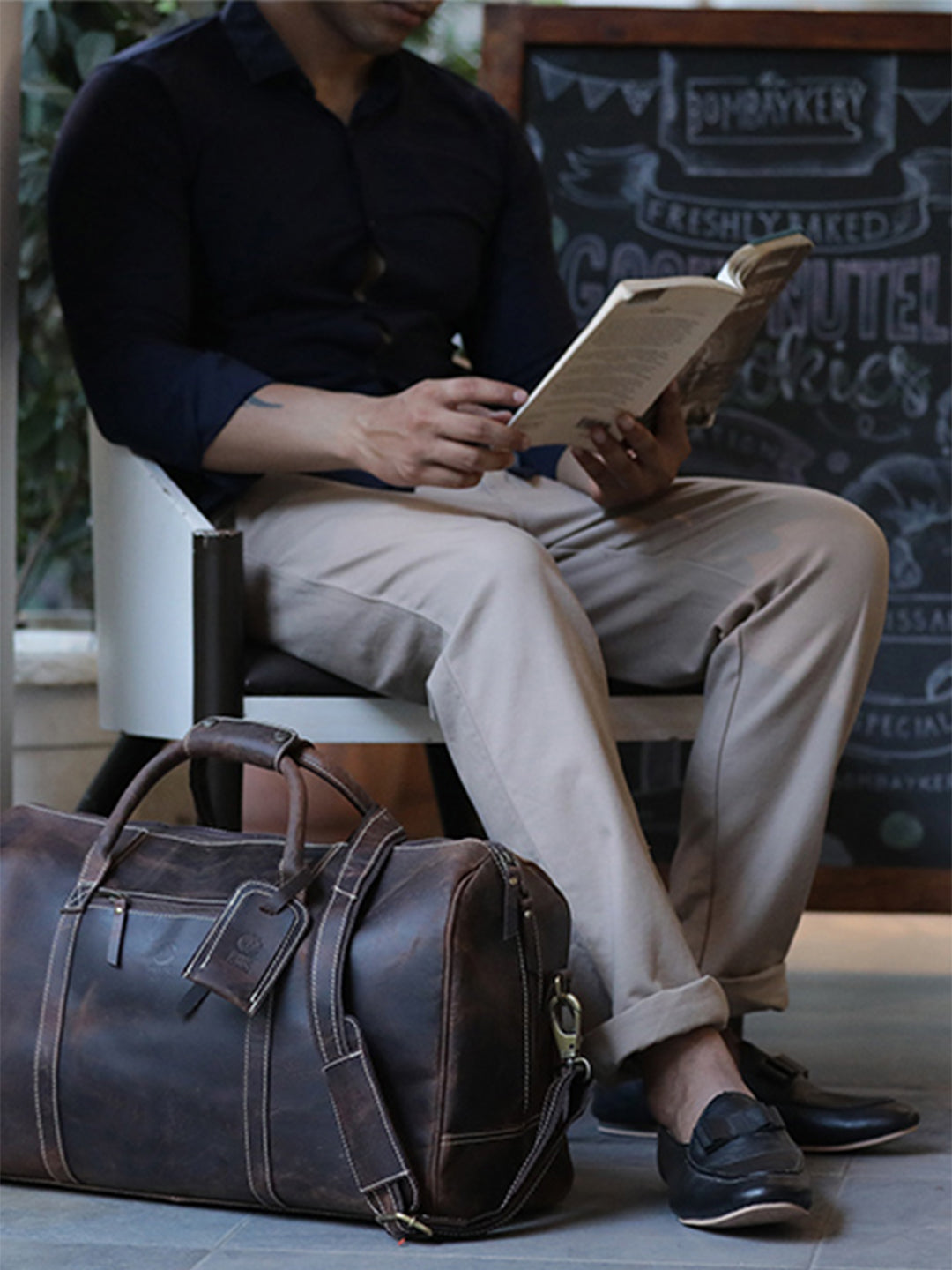
The two-bag travel formula that works for almost everyone: a soft leather duffel or weekender as the overhead bag, and a messenger as the personal item. Pack the duffel with clothes and the dopp kit; keep the laptop, documents, chargers, and anything you need in-flight in the messenger. For a 2-3 day work trip, that combination clears check-in counters entirely and means you are never the person waiting at a carousel.
Is There a Third Option? (Satchels and Backpacks)
Yes, two. A satchel splits the difference: slimmer and more structured than a messenger bag, still worn crossbody, with a heritage look that suits academic and creative settings - browse leather satchels for men if that silhouette appeals. And if your daily load exceeds 7-8 kg (laptop plus gym kit plus lunch), skip both styles and choose a leather backpack - two straps distribute weight a single crossbody strap cannot.
For overnight work trips, none of these replaces a proper weekender; a leather travel bag paired with a messenger bag as your personal item covers a 2-3 day trip without checked luggage.
Who Should NOT Buy Either?
Honest section. If you cycle daily through heavy rain, waxed canvas or technical synthetic is more practical than leather - leather handles drizzle fine but dislikes repeated soakings. If you carry heavy or fragile equipment (camera rigs, tools, product samples), a padded technical backpack protects gear better than any unstructured leather bag. And if your "work bag" is really a gym-plus-office bag, buy a duffel and a slim laptop sleeve instead of forcing one bag to do both jobs badly.
The 60-Second Buying Checklist
Before you buy any work bag - here or anywhere - check these five things:
- Leather grade: the listing must say full-grain. "Genuine leather" is a downgrade dressed as a compliment.
- Laptop fit: check the stated laptop size, not the bag's outer dimensions - padding eats 1-2 inches.
- Hardware: solid metal buckles and rings. Plated plastic is the most common failure point.
- Stitching: double-stitched at strap anchors and the base seam.
- Strap: wide, adjustable, and ideally padded if you carry over 4 kg daily.
A bag that passes all five will outlast five bags that do not.
Frequently Asked Questions
Is a messenger bag professional enough for an office job?
Yes. A full-grain leather messenger bag in brown or black is appropriate for business-casual and most suit-level offices. Only the most formal environments (courtrooms, traditional banking) still expect a structured briefcase, and a hybrid briefcase with a shoulder strap covers even those.
Can a messenger bag replace a briefcase completely?
For most professionals, yes. A 15-16 inch leather messenger bag carries everything a briefcase does, adds hands-free comfort, and suits modern dress codes. Keep a briefcase only if your industry treats it as part of the uniform.
Are messenger bags bad for your back?
Not at typical loads. Under 5-6 kg, a crossbody strap worn across the torso is comfortable for daily commutes. Above 7-8 kg, switch to a backpack - any single-strap bag, messenger or briefcase, will fatigue one shoulder at that weight.
What is the best leather for a work bag?
Full-grain leather. It is the strongest layer of the hide, develops a patina rather than peeling, and lasts decades. Avoid "genuine leather" and bonded leather, which are lower grades that crack and delaminate within a few years.
How much does a good leather messenger bag cost?
A handcrafted full-grain leather messenger bag costs $39.99 to $99.45 at Rustic Town, depending on size. Comparable full-grain bags from designer labels cost $300-$600, so under $100 is the realistic benchmark for honest full-grain quality.
Do messenger bags fit a 16 inch laptop?
Yes, if you buy the right size. Rustic Town's 16 inch Ranger Buffalo messenger bag fits laptops up to 16 inches in a padded compartment, with space for chargers and A4 documents. Always check the stated laptop size, not just the bag's outer dimensions.
Is a briefcase outdated in 2026?
The rigid, hard-shell attaché is largely outdated; the soft leather briefcase is not. Modern leather briefcases with detachable shoulder straps remain standard in formal industries and double as structured messenger bags for everyone else.
Messenger bag or backpack for commuting?
Messenger bag if your daily load is under 6 kg and you value fast access; backpack if you carry more, cycle long distances, or have existing shoulder issues. Many commuters keep both and pick by the day's load.
What colour work bag is most versatile?
Brown full-grain leather. It suits every dress code short of black-tie formality, hides daily wear better than black, and develops the most visible, attractive patina. Black is the safer pick only for strictly formal industries.
What should I look for when buying a work bag?
Five things: full-grain leather (not "genuine"), a padded laptop compartment matched to your laptop size, solid metal hardware, double-stitched stress points, and a wide adjustable strap. A bag with all five will outlast five bags without them.
Written by Pankaj Gupta, Founder of Rustic Town, where every bag is handcrafted from full-grain leather by skilled artisans. Connect on LinkedIn.