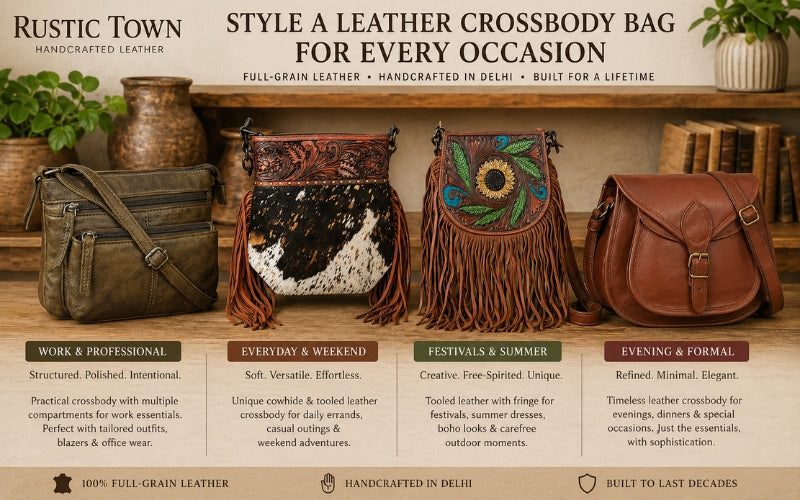
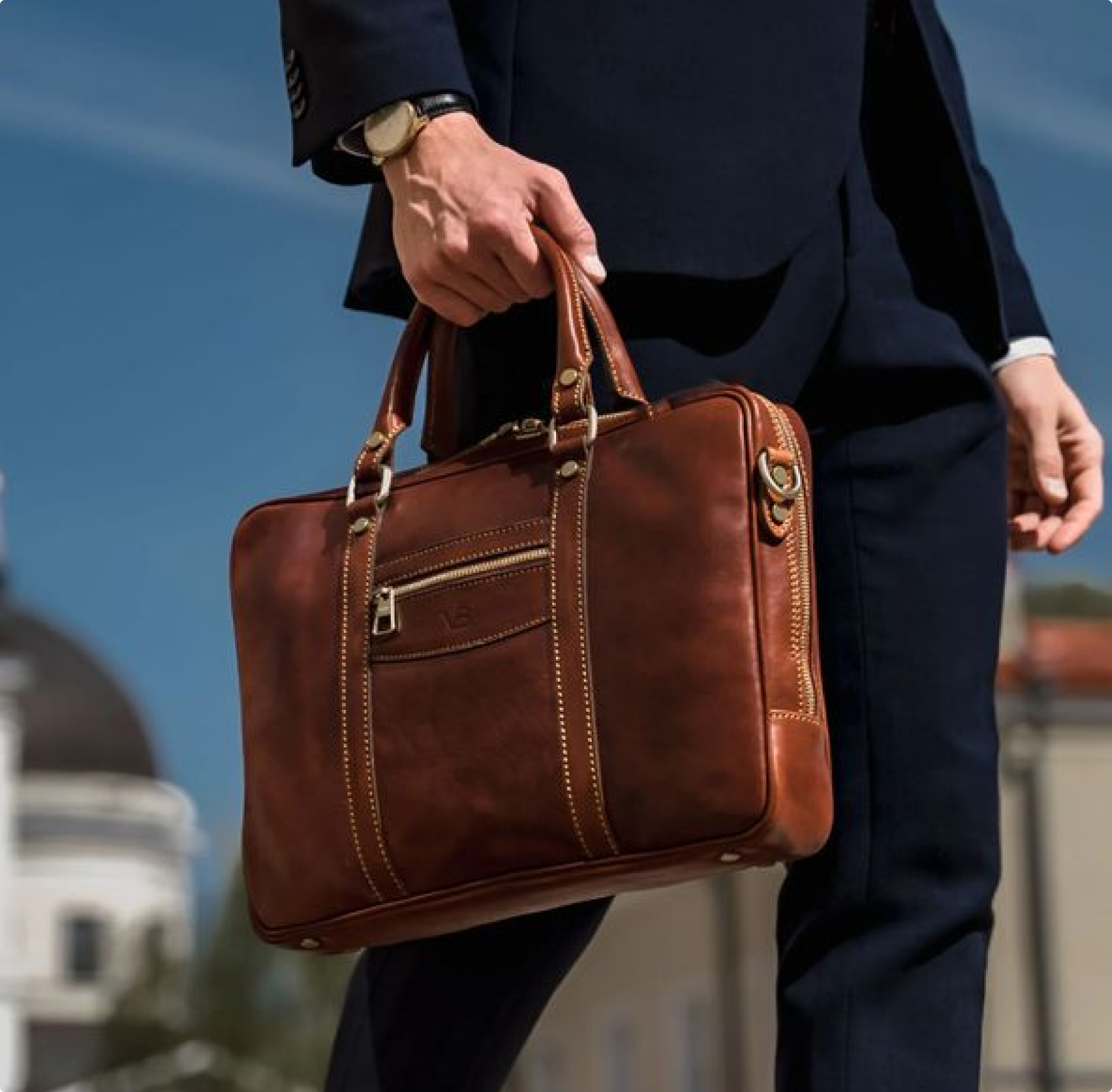



A satchel bag is a structured rectangular leather carry with a closed top, a sturdy front flap that closes over the main compartment with magnetic or strap closure, and dual carrying options - a top handle for hand or elbow carry and a shoulder strap for crossbody or single-shoulder wear.
A mens satchel bag differs from a messenger bag in structure, closure mechanism, and intended use context: the satchel bag men is more formally structured with a closing flap and is appropriate for professional and educational contexts, while a messenger is more casual with an open top and is designed for active carry and frequent access. The satchel has been the standard professional carry since the 1920s. The messenger evolved from the postal worker's bag and functions differently.

The confusion between satchels and messengers exists because both are shoulder-carry bags with similar silhouettes in product photos. But the structural differences run deep. A satchel bag with its closed flap and formal closure is built for contexts where the bag stays relatively stationary - the office desk, the classroom, the professional meeting. A full grain satchel prioritises protection of the contents and the signal of order and professionalism. A messenger bag with its open top is built for contexts where the contents need to be constantly accessed - the courier delivery, the active commute, the creative workspace. The messenger prioritises access over protection and formality.
This guide covers exactly what a mens satchel bag is, the complete structural differences between satchel and messenger formats, when each is appropriate, what to look for in a quality satchel bag men that lasts a career, how to pack and maintain a satchel, and the questions that determine whether a satchel or messenger is right for your actual working context rather than just your aesthetic preference.
Rustic Town's satchel bag collection - full-grain leather, structured format, hand-stitched flaps, handcrafted in Delhi from under $120.
What Defines a Satchel Bag? The Complete Anatomy
A satchel bag is defined by specific structural features that distinguish it from every other shoulder-carry category. Understanding these features explains why a satchel works in some contexts and fails in others.
What Are the Core Structural Features of a Satchel Bag?
A rectangular or slightly tapered body.
The body of a mens satchel bag is structured and geometric - not slouchy, not curved, not organic. The shape is typically rectangular or slightly tapered at the sides for ergonomic carry. This structured geometry is the defining visual difference between a satchel bag men and a slouchy messenger or hobo bag. The structure supports the formal signal the satchel sends.
A front flap closure covering the main compartment.
The front flap is the iconic satchel feature. The flap covers the entire front of the main compartment and fastens with a magnetic snap, leather strap buckle, or combination closure. The flap serves both practical and symbolic purposes: practically, it protects the contents from weather and accidental opening; symbolically, it signals order, professionalism, and intentionality. A full grain satchel with a well-designed flap communicates that the contents are secured and the wearer takes them seriously.
Dual carrying handles.
A quality leather satchel bag has both a top handle for hand or elbow carry and a shoulder strap for shoulder or crossbody wear. The top handle is typically reinforced leather strap. The shoulder strap is typically adjustable and detachable or fixed. The dual-handle design gives the carrier options for how to wear the bag depending on the context.
Reinforced corners and base panel.
The corners and base of a mens satchel bag are reinforced with extra stitching or metal corner hardware. These stress points are where wear concentrates - the base contacts the ground or chair, the corners flex when the bag is set down or lifted. Reinforcement at these points is what extends the lifespan of a satchel from 5-7 years to 15-20+ years.
An organised interior with dedicated pockets and compartments.
The interior of a satchel bag is typically more organised than a messenger. Multiple compartments, a dedicated laptop or documents sleeve, pen pockets, and card slots transform the satchel from a single large space into a structured filing system. This organisation is what makes the mens satchel bag appropriate for professional and educational contexts where organisation matters.
Quality hardware and stitching visible throughout.
A full grain satchel that lasts a career has visible saddle-stitch stitching at all seams, solid brass or quality hardware at all attachment points, and reinforced stitching at stress points. Machine stitching that is inconsistent, hidden glue at seams, or cheap hardware are red flags that the satchel is not built to last.

|
Feature |
Satchel Bag |
Messenger Bag |
Briefcase |
Backpack |
|
Body structure |
Rectangular, structured |
Slouchy, organic |
Rectangular, rigid |
Ergonomic, padded |
|
Main closure |
Front flap with snap/strap |
Open top |
Zip across top |
Zip top |
|
Top handle |
Yes - reinforced |
Minimal or none |
Yes - reinforced |
Loop handles only |
|
Shoulder strap |
Yes - adjustable |
Yes - fixed or adjustable |
No typically |
Yes - padded straps |
|
Interior organisation |
High - compartments and pockets |
Low to moderate - main space |
High - structured dividers |
Moderate - pockets |
|
Laptop capacity |
Yes - dedicated sleeve common |
Yes but loose |
Yes - dedicated compartment |
Yes - padded sleeve |
|
Professional signal |
Very high |
Casual to creative |
Very high |
Moderate |
|
Weather protection |
Good - flap covers top |
Moderate - open top vulnerable |
Good - closed structure |
Good - closed structure |
|
Daily access ease |
Moderate - must open flap |
High - instant access |
Low - must unlock |
Moderate - strap opening |
What Is the Difference Between a Satchel and a Messenger Bag?
The satchel vs messenger distinction is the most important bag category question most professional carriers ask. Both are shoulder-carry bags. Both are appropriate for daily use. But the structural differences make each appropriate for different working contexts.
How Does the Satchel Differ from the Messenger at the Structural Level?
Closure mechanism.
A satchel bag has a front flap with a positive closure (magnetic snap, buckle, or strap) that fully secures the main compartment. A messenger bag typically has an open top - the contents are accessible instantly without opening anything. A mens satchel bag prioritises security and protection. A satchel bag men messenger prioritises instant access.
Silhouette and structure.
A full grain satchel is visibly structured and geometric - rectangular body, defined shoulder line, crisp edges. A messenger is typically more slouchy and organic - the body softens and collapses slightly without contents. The satchel's structure is part of its professional signal. The messenger's softness is part of its casual signal.
Intended carry context.
A satchel bag is built for contexts where the contents stay relatively protected and stationary - the office desk, the classroom, the professional environment. The bag sits on a chair or desk for hours with the contents secure inside. A messenger is built for contexts where the contents are constantly accessed - the delivery route, the active commute, the creative workspace where instant access matters more than protection.
Interior organisation.
A quality mens satchel bag has multiple compartments and pockets - a filing system for documents, dedicated slots for devices, card pockets, pen holders. A messenger typically has a single large main compartment with perhaps one or two front pockets. The satchel's organisation supports stationary use. The messenger's simplicity supports quick access.
When Is Each Bag Appropriate?
Choose a satchel bag when:
You work in a professional office environment where the bag stays relatively stationary on your desk or under your desk during the workday. You carry documents, devices, and items that benefit from organisation and protection. You attend meetings where the bag's professional signal matters. You want a bag that lasts 15-20+ years and improves with age. You value structure and organisation in how you carry your daily necessities.
Choose a messenger bag when:
You need constant access to your contents throughout the day without opening anything - courier work, active commuting, creative environments. You prefer a casual aesthetic that reads as relaxed rather than formal. You want maximum flexibility in how you organise the interior. You prioritise ease of access over protection from weather and accidental opening.
|
Working Context |
Best Choice |
Why |
Second Best |
Why It Works But... |
|
Corporate office |
Satchel bag |
Professionalism, organisation, protection |
Messenger bag |
Too casual for most corporate contexts |
|
Creative agency |
Messenger bag |
Casual, creative signal, instant access |
Satchel bag |
Satchel reads too formal for creative spaces |
|
University/student |
Satchel bag |
Organisation, professional development, durability |
Messenger bag |
Messenger more casual, less organised |
|
Freelance/home office |
Either works |
Context dependent - depends on video calls and client meetings |
Depends |
Choose based on your specific context |
|
Active commuting/delivery |
Messenger bag |
Instant access, comfort, casual signal |
Satchel bag |
Satchel's structure feels formal for active work |
|
Legal/professional services |
Satchel bag |
Documents organisation, protection, professionalism |
Briefcase |
Satchel more flexible than rigid briefcase |
|
Art/design studio |
Messenger bag |
Casual, creative signal, flexibility |
Satchel bag |
Satchel feels too formal |
|
Teaching/academia |
Satchel bag |
Organisation, device protection, professional signal |
Messenger bag |
Works but satchel better for classroom context |
Rustic Town's mens satchel bag collection - structured full-grain leather, front flap closure, hand-stitched throughout.
What Should You Look for in a Quality Satchel Bag That Lasts?
Not every satchel bag is built to last. The market includes poorly constructed satchels with weak stitching, cheap hardware, and thin leather that fail within 2-3 years. A quality leather satchel bag built at full-grain level lasts 15-20+ years and improves visibly through use.
What Are the Quality Markers in a Professional Satchel Bag?
Full-grain leather construction - not top-grain, not bonded.
The single most important quality marker in a mens satchel bag is full-grain leather. Bonded leather (composite with 10-17% leather content) and PU 'leather' (zero leather content) satchels look reasonable when new and deteriorate within 2-3 years. Full-grain leather develops patina and becomes more beautiful with use. Full-grain is the only grade worth investing in for a professional satchel.
Hand-stitched or quality visible machine stitching throughout.
A satchel bag with weak or hidden stitching fails at the stress points - handle attachment, flap hinge, base corners - within months to years depending on use intensity. A full grain satchel with visible consistent saddle-stitch stitching at all seams is built to last. Check that stitching is even, consistent, and present at all stress points.
Reinforced flap construction and closure hardware.
The front flap is where the satchel's protection quality is most visible. The flap should have reinforced stitching at the hinge point where it attaches to the body. The closure hardware - whether magnetic snap, buckle, or strap - should be solid brass or quality steel. Cheap hardware fails or wears after months of daily use.
Reinforced corners and base with extra stitching or metal feet.
The base and corners of a mens satchel bag experience the most contact stress - the bag is set down hundreds of times, the corners flex during carry, the base drags on surfaces. Reinforced construction at these points is what extends a satchel from 5-year durability to 15+ year durability. Check that the base and corners have visible reinforcement.
Quality leather hardware - handles and strap.
The top handle and shoulder strap of a satchel bag men should be constructed from quality leather that matches the bag body or is a comparable grade. Cheap synthetic or thin leather handles deteriorate within the first year of regular use. The handle should feel substantial - not flimsy or thin - and the stitching at the handle attachment points should be reinforced.
Archival-quality paper or protective lining inside.
The interior of a leather satchel bag should have protective lining - either high-quality fabric or archival paper - that protects the leather interior from the items carried inside. Without interior lining, keys, coins, and sharp objects wear the interior leather within months. Quality lining extends the interior's lifespan significantly.
|
Quality Marker |
Premium Indicator |
Acceptable |
Avoid |
Why It Matters |
|
Leather grade |
Full-grain leather |
Top-grain leather |
Bonded or PU leather |
Only full-grain lasts 15+ years |
|
Stitching |
Hand-stitched or even machine-stitched |
Consistent machine stitching |
Weak, hidden, or inconsistent stitching |
Determines structural longevity |
|
Flap construction |
Reinforced hinge with double-stitch |
Clean single-stitch at hinge |
Minimal stitching at hinge |
Flap hinge is high-stress point |
|
Hardware |
Solid brass or quality stainless steel |
Plated steel |
Cheap zinc alloy, very light |
Hardware longevity to match leather |
|
Corners and base |
Visible reinforcement or metal feet |
Standard construction |
No visible reinforcement |
Most contact-stress areas |
|
Handles |
Leather to match body or quality leather |
Reinforced synthetic |
Thin synthetic, minimal stitching |
Handles bear full weight daily |
|
Interior lining |
Archival fabric or high-quality paper |
Standard cotton or canvas |
No lining or cheap plastic |
Protects interior leather longevity |
|
Edge finishing |
Hand-burnished or sealed edges |
Machine-finished edges |
Raw or unfinished edges |
Shows level of craftsmanship overall |

See Rustic Town's full grain satchel specifications - hand-stitched construction, reinforced corners, quality hardware throughout.
How to Pack a Satchel Bag for Professional and Daily Use
The way you pack a satchel bag determines how long the bag lasts and how functional it is across a working day. Efficient packing extends the lifespan and improves accessibility.
Step 1. Use the front flap pocket for items accessed frequently during the day.
Most mens satchel bag designs include a shallow front pocket under the flap. Use this space for items you access without fully opening the main compartment: phone, keys, lip balm, transit pass. Keep this pocket uncluttered - overfilling strains the flap closure.
Step 2. Organise the main compartment by weight and frequency of access.
Heavy items - books, laptops, water bottles - go at the base of the satchel bag for stable weight distribution. Medium-weight items - folders, notebooks - in the middle. Light items - pen cases, small accessories - at the top where they are accessible.
Step 3. Use internal compartments deliberately.
A quality leather satchel bag has multiple compartments. Assign each a purpose: one for documents, one for devices, one for personal items. This system means you know exactly where everything is without excavating the entire bag.
Step 4. Place the laptop or tablet in the dedicated sleeve.
If your mens satchel bag has a dedicated device sleeve (most quality satchels do), use it exclusively for your device. This protects the device from contact with sharp objects and provides padding from impacts. Never transport a device loose in the main compartment.
Step 5. Keep the base and corners clear of small items.
Small items - coins, paper clips, USB drives - collect in the corners and base where they are hard to find. Keep a dedicated small pouch or pocket for these items rather than loose in the main compartment.
Step 6. Do not overload the satchel to the strain point.
A full grain satchel can technically hold more than its practical maximum - the material is strong enough. Overloading to the point where the handles strain under weight accelerates handle deterioration. Load to about 80% of capacity to give the bag longevity.
Step 7. Leave the main compartment zoned rather than mixed.
Documents stay in their compartment, devices stay in theirs, personal items stay in theirs. The moment you start mixing contents across compartments, the organisation system collapses and the bag becomes frustrating to use.
Step 8. Empty the satchel completely at the end of each workday or workweek.
Take everything out. Wipe the interior if needed. Leave the bag open to air briefly. This practice prevents items from being forgotten in the bag and allows you to notice if anything inside needs attention - a pocket that is wearing, a strap that is loosening, dust accumulation.
How Do You Care for a Leather Satchel Bag to Make It Last 20 Years?
A satchel bag built from full-grain leather with quality construction lasts 20-30+ years of daily professional use with proper care. The care routine is simple but specific.
|
Action |
Method |
Frequency |
Why |
|
Wipe exterior |
Dry cloth on leather surfaces |
After use if needed |
Removes dust and light grime before accumulation |
|
Clean flap hinge |
Soft brush on stitching area |
Monthly |
Hinge is high-stress area - keeps stitching clear |
|
Condition leather |
Beeswax or lanolin on all exterior surfaces |
Every 6 months |
Replenishes grain oils depleted by use |
|
Inspect hardware |
Check closure function, handle stitching |
Every 6 months |
Catches early wear before failure |
|
Empty and air dry |
Remove all contents, leave open to air |
End of workday |
Prevents moisture accumulation and item forgotten inside |
|
Treat water exposure |
Blot moisture, air dry completely |
Immediately after exposure |
Prevents water staining and moisture damage |
|
Polish brass hardware |
Brass polishing cloth on hardware |
Every 12 months |
Keeps hardware looking quality, prevents tarnish |
|
Check base and corners |
Visual inspection for damage signs |
Every 3 months |
Catches base wear before it becomes structural |
What Should You Never Do to a Leather Satchel Bag?
Never machine wash a mens satchel bag - the agitation and water destroy leather structure and stitching. Never store the satchel stuffed or compressed for extended periods - the leather takes permanent creases. Never use silicone sprays or waterproof coatings - they seal the grain and prevent conditioning. Never apply conditioner to the interior - condition only the exterior leather. Never overload beyond reasonable capacity - the strain damages the handles and flap closure permanently.
Find Rustic Town's satchel bag men care guides - all included with purchase, covering full 20-year professional use maintenance.
Should You Choose a Satchel or a Messenger for Your Working Context?
The final decision between a satchel bag and a messenger comes down to your actual working context - not your aesthetic preference, not the look you want to project, but the reality of how you actually work and what you actually need from a carry bag.
What Questions Determine the Right Choice?
How often do you need to access your bag's contents?
Multiple times per hour, without fully opening the bag: messenger. A few times per day, when you can spend 3-5 seconds opening the flap: satchel. Instant access throughout the day is where the messenger excels. Professional stationary carry is where the satchel bag excels.
What is your professional environment's dress code?
Corporate or formal professional: mens satchel bag is the better choice. Creative, casual, or startup: messenger is often a better fit. Academic: satchel. The environment where the bag sits influences whether its formal or casual signal is appropriate.
How much organisation does your work require?
Work that requires finding specific items quickly (teaching, business meetings, document management): satchel's compartmentalisation helps. Work where contents are dumped and dug through regularly: messenger's simplicity actually works better.
How much weight do you carry daily?
Light carry (laptop and notebook only): either works. Heavy carry (books, documents, multiple devices): a full grain satchel with reinforced handles distributes weight better. A messenger with a single shoulder strap strains under heavy load.
How long do you want the bag to last?
5-7 years is acceptable: either works depending on use. 15-20+ years is the goal: a full-grain leather satchel bag is the more durable choice. Messengers can be built to last long-term too, but the satchel's structure and closure mechanism age better under sustained professional use.
|
Decision Factor |
Satchel Bag Better |
Messenger Better |
Equally Viable |
Key Question |
|
Access frequency |
Occasional access |
Constant access |
Depends on your work |
How often do you open it daily? |
|
Professional environment |
Corporate, formal |
Creative, casual |
Academic, startup depends |
What is the dress code? |
|
Organisation needs |
High organisation required |
Low organisation needed |
Depends |
Do you need compartments? |
|
Weight of daily carry |
Heavy load |
Light load |
Moderate load |
How much do you carry? |
|
Longevity goal |
20+ year investment |
5-10 year acceptable |
Depends |
How long should it last? |
|
Weather exposure |
Indoor work |
Outdoor/active carry |
Mixed use |
Are you in and out? |
|
Style signal required |
Professional, intentional |
Casual, creative |
Neutral context |
What signal matters? |
|
Daily movement |
Stationary at desk |
Active throughout day |
Mixed |
How much do you move? |
Explore Rustic Town's complete satchel bag and professional carry collection - satchels for every professional context, handcrafted in Delhi from under $120.
Frequently Asked Questions: Satchel Bags vs Messengers
Q: What exactly is a satchel bag?
A: A satchel bag is a structured rectangular leather carry with a closed front flap, dual handles (top handle plus shoulder strap), organised interior compartments, and a positive closure mechanism (snap or buckle). The satchel is built for professional and educational contexts where the bag stays relatively stationary and protection of contents matters.
Q: What is the main difference between a satchel and a messenger?
A: The satchel has a closed front flap with positive closure that fully secures the main compartment. The messenger has an open top for instant access without opening anything. The satchel prioritises protection and professionalism. The messenger prioritises instant access and casual signal.
Q: Which is better for professional use - satchel or messenger?
A: Satchel is better for traditional corporate and professional contexts. Messenger is better for creative and casual professional environments. Your specific working context - not general 'professional' - determines which is right. A corporate lawyer should choose satchel. A creative agency designer might prefer messenger.
Q: How long does a full-grain leather satchel bag last?
A: A full-grain leather satchel with proper construction and care lasts 15-20+ years of daily professional use. Many leather satchels from 20-30 years ago are still in active professional use today. Bonded or PU satchels last 2-3 years before surface deterioration.
Q: Can you wear a satchel bag casually?
A: Yes - a satchel bag works for smart-casual, weekend, and some casual contexts depending on the leather finish and colour. A tan or brown leather satchel pairs with jeans and a sweater. A black leather satchel works for evening and dressier casual. The structure reads slightly more formal than a messenger, which affects the casual pairing.
Q: What size satchel bag is most versatile?
A: Medium - approximately 38-42cm wide by 28-32cm tall. This size holds a laptop, documents, notebooks, daily essentials, and accessories without becoming oversized or cumbersome. Larger satchels (over 45cm wide) become bulky for varied contexts. Smaller satchels (under 35cm wide) become limiting for daily professional carry.
Q: What colour satchel bag is most professional?
A: Black or dark brown are the most conservative professional choices that work in any formal context. Tan, cognac, and burgundy work for professional contexts with slightly more style flexibility. Navy and forest green work for professional use with personality. Avoid bright colours for formal corporate environments.
Q: Is a satchel bag good for travel?
A: Yes - a medium satchel bag works well for business travel and short trips (2-4 days). The structure keeps the contents organised, the top handle allows easy airport carrying, and the shoulder strap works for crossbody carry through terminals. For longer trips, a larger satchel or an additional bag is usually needed.
The Short Answer: What Is a Satchel and Why Does It Matter?
A satchel bag is a structured rectangular leather carry with a closed front flap, dual carrying options, organised interior, and a positive closure mechanism. The satchel differs from a messenger in closure mechanism (flap vs open top), structure (geometric vs slouchy), and use context (stationary professional vs active courier). The mens satchel bag is built for professional and educational contexts where protection and organisation matter more than instant access.
The satchel vs messenger distinction matters because choosing the wrong bag for your working context results in daily friction - a messenger in a professional context feels too casual, a satchel in an active creative environment feels overly formal. Understanding what each bag is built for and which matches your actual working reality eliminates the daily compromise most professionals accept.
A full grain satchel built with quality construction lasts 15-20+ years of daily professional use - the longest-lasting shoulder carry in any category. A satchel bag men improves with age, develops personal patina through years of use, and becomes a professional tool that the wearer comes to rely on completely. The investment in a quality leather satchel returns itself across the decades the bag serves.
Start with Rustic Town's satchel bag collection - full-grain leather, hand-stitched construction, reinforced throughout, built for a 20-year professional career, handcrafted in Delhi.