

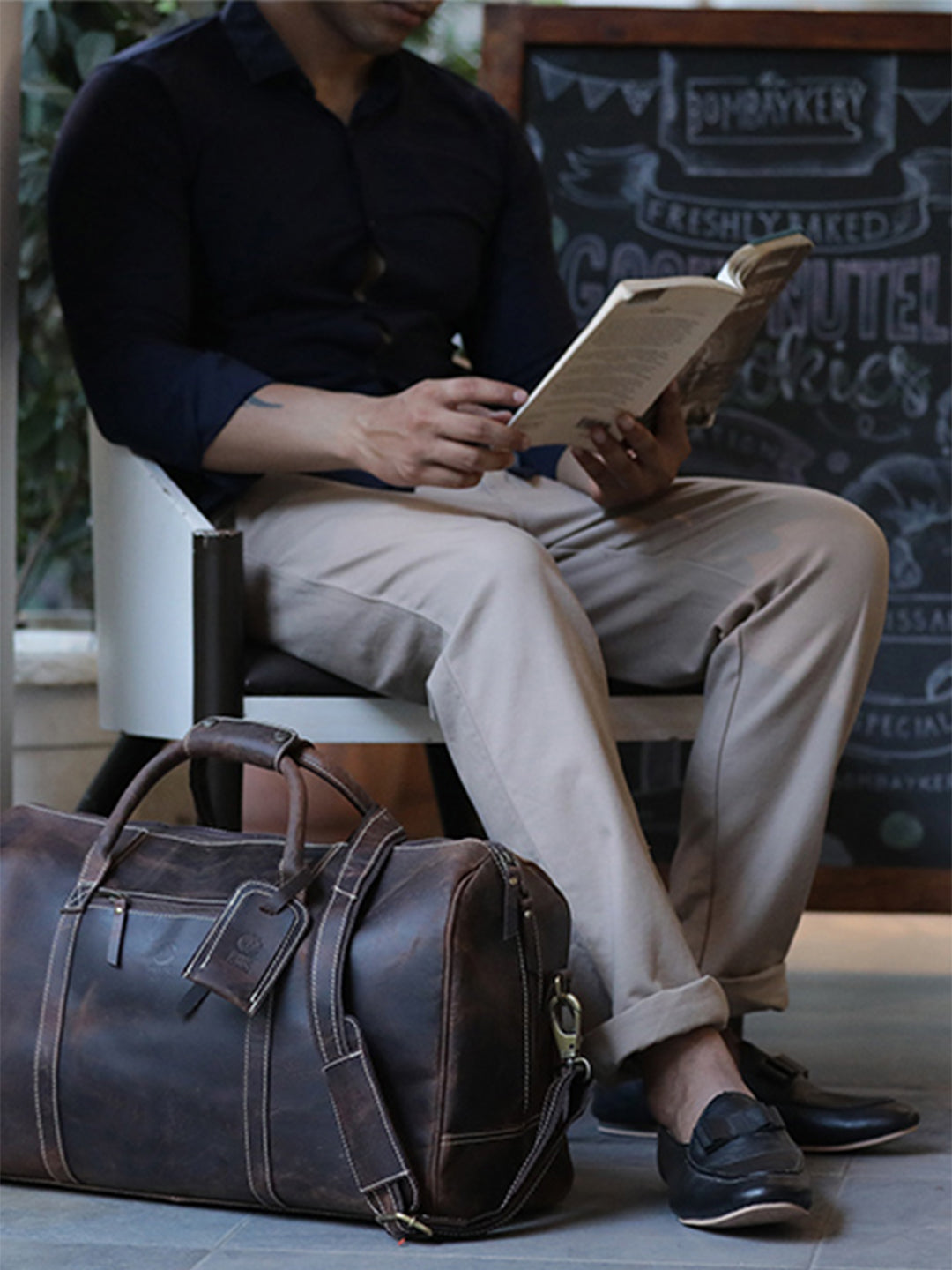

A leather duffle bag - also spelled leather duffel bag - is a soft-sided structured carry bag made from full-grain or top-grain leather with reinforced dual handles, a wide-mouth zip closure, an organised interior, and a detachable shoulder strap, designed to handle overnight travel, gym use, and weekend trips in a single bag that improves with every year of use.
If you are reading this, you are probably standing between two kinds of decisions. Either you are buying a leather duffle bag for the first time and do not want to waste money on something that disappoints within a year. Or you already own one that let you down - a strap that detached, a zip that failed, a surface that started peeling after 18 months - and you want to get it right this time.
This guide covers everything that actually matters when choosing a leather duffel bag: the leather grade hierarchy, construction details that determine lifespan, sizing for real-world use, carry options, interior organisation, and the questions to ask before buying at any price point. Read it once and you will not need to read another leather bag buying guide again.

What Is the Leather Grade Hierarchy and Which Grade Should Your Duffle Bag Be?
This is where most buyers go wrong, and where the leather accessories industry does its most effective consumer deception. There are four leather grades in commercial bag production. Understanding the difference between them changes every leather bag purchase you make for the rest of your life.
What Is Full-Grain Leather and Why Is It the Only Grade Worth Buying for a Daily Carry Bag?
Full-grain leather is the outermost layer of the hide with the complete natural grain surface completely intact and unmodified. Nothing has been sanded off, buffed down, or corrected. The tight, densely packed fibres at this top layer give full-grain leather its durability, its natural water resistance, and - critically - its ability to develop a patina through use rather than deteriorating toward failure. A full-grain leather duffel bag carried daily for five years looks more distinguished than the day you bought it. No other leather grade does this.
The natural grain on full-grain leather means every bag has slight surface variation - small marks, tonal differences, the individual character of that specific hide. This is not a defect. It is the evidence that the leather has not been processed into uniformity. Uniform, flawless leather surfaces are a red flag, not a quality signal.
What Is Top-Grain Leather and Is It Acceptable in a Leather Travel Bag?
Top-grain leather is the same top layer as full-grain but the surface has been lightly sanded to remove natural blemishes, then pigmented to a uniform tone. It is still a good leather - genuinely durable and suitable for a leather travel bag used regularly - but the sanding compromises the fibre density at the surface, reducing lifespan from 15-20 years to 8-12 years and limiting the depth of patina development. For a leather duffel bag at a mid-range price point, top-grain is an acceptable choice. For a bag you want to carry for 20 years, push for full-grain.
What Is Genuine Leather and Why Should You Avoid It in a Duffle Bag?
This is the trap. Genuine leather sounds like a quality assurance - it is genuine, after all. In the leather industry, genuine leather is the lowest commercial grade: the lower layers of the hide split off after the top grain has been removed, compressed with adhesive onto a backing material, and given a surface coating that makes it look like leather in a product photo. It has none of the structural density of full-grain leather.
Under the repeated mechanical stress of loading, carrying, and unloading a duffle bag, genuine leather peels, cracks, and delaminated within 18 to 36 months. Any bag described only as genuine leather, premium leather, or quality leather without specifying the grade should be treated as genuine leather until proven otherwise.
|
Leather Grade |
Surface Condition |
Patina Development |
Daily Use Lifespan |
Cost Per Year |
Verdict for Duffel Bags |
|
Full-grain |
Natural grain - completely intact |
Excellent - deepens with use |
15-20+ years |
$5-7 |
Only grade worth buying for long-term use |
|
Top-grain |
Sanded and pigmented - uniform |
Moderate |
8-12 years |
$9-14 |
Acceptable at mid-range price points |
|
Corrected-grain |
Heavily processed - embossed pattern |
Minimal |
4-7 years |
$15-25 |
Avoid for daily or travel use |
|
Genuine / bonded |
Compressed scraps - surface coating only |
None - peels and cracks |
1-3 years |
$30-60 |
Do not buy for any regular use bag |
Rustic Town's leather duffle bags use full-grain leather stated explicitly on every product page - no ambiguity, no vague grade language.

What Construction Details Determine How Long a Leather Duffel Bag Actually Lasts?
Two bags can use identical full-grain leather and deliver completely different lifespans based on construction quality. A leather weekend bag built with machine lockstitch and zinc alloy hardware fails at the seams and zip pulls within four to five years of regular use. The same leather with saddle-stitch construction and solid brass hardware is still fully functional at 15 years. Here is what to look for in the construction spec before you buy.
What Is the Difference Between Saddle Stitch and Machine Lockstitch?
Saddle stitching uses two needles working simultaneously from opposite sides, threading waxed linen or polyester thread through each hole so the two threads interlock at every stitch point. If one thread breaks at any single point - through abrasion, a sharp object, or simple wear - the interlocked thread at that stitch holds the seam closed. The break does not propagate. The seam does not unravel.
A machine lockstitch uses a single thread that links through itself at each stitch point. If that thread breaks anywhere in the seam, the seam can unravel progressively from the break point outward. Under the sustained mechanical stress of a regularly loaded leather gym bag - opened and closed 300-plus times a year, carried by the handles with 10-15 kg of load - machine stitching at the handle attachment seams begins to show progressive failure within three to five years. Saddle stitching at the same seam is intact at 15 years.
When examining a leather duffle bag, look at the stitch spacing. Saddle stitching has slightly irregular spacing because it is hand-applied. Machine stitching is metronomically uniform. Slight irregularity in stitch spacing is a quality indicator, not a defect.
What Hardware Should a Quality Leather Duffle Bag Have?
The zip pulls, D-rings for the shoulder strap, handle attachment hardware, and any buckles on a leather duffel bag are opened, clipped, and loaded thousands of times across the ownership period of a daily use bag. Hardware material determines whether these components are still functioning at year 10 or have been replaced twice.
Solid brass hardware.
Solid brass has the density and corrosion resistance to handle daily mechanical use for 15-20 years. It develops a warm patina alongside the leather - deepening in tone rather than tarnishing. Solid brass stated in the product specification is the quality indicator.
Zinc alloy hardware.
Zinc alloy is lighter and cheaper than solid brass. It handles 3-5 years of regular use before showing surface pitting, tarnishing, and eventual structural failure at the loading points. Most budget leather bags use zinc alloy without stating it explicitly. If the hardware material is not specified, assume zinc alloy.
YKK or equivalent quality zips.
The main compartment zip on a leather travel bag is opened and closed an average of 300-500 times per year for a bag in regular travel and daily use. A YKK zip - the industry standard for zip reliability - handles this use frequency across the full ownership period of a quality leather bag. The zip pull should be leather or solid brass, not plastic, which becomes brittle under repeated use.
What Makes Handle Attachment the Most Critical Construction Point?
The dual top handles of a leather duffel bag carry the full weight of the loaded bag at two concentrated points every time the bag is lifted. A medium leather duffle loaded for a weekend trip can weigh 12-15 kg. Applied to handle attachment points twice a day across 15 years of regular travel, that represents a sustained mechanical load that weak attachment construction cannot survive.
The correct specification is double saddle-stitching at the handle attachment points with a solid brass rivet or washer distributing the load across a wider area of the leather body panel. Single-row stitching without a rivet pulls through the leather body under sustained heavy loading. This is the most common single point of failure on under-specified leather duffle bags - and it is entirely avoidable by checking the attachment construction before purchase.
|
Construction Element |
Quality Specification |
Poor Specification |
Failure Timeline (Poor) |
|
Stitching type |
Saddle stitch - two-needle waxed thread |
Machine lockstitch - single thread |
3-5 years at handle seams under regular heavy load |
|
Handle attachment |
Double saddle stitch + solid brass rivet |
Single row machine stitch - no rivet |
2-4 years under regular 10kg+ loading |
|
Main zip |
YKK full-width zip - leather or brass pull |
Unbranded zip - plastic pull |
2-3 years of 300+ open-close cycles per year |
|
D-ring hardware |
Solid brass - welded ring |
Zinc alloy - stamped ring |
3-5 years before strap attachment failure |
|
Base panel |
Reinforced leather or fitted base board |
Single layer leather - no reinforcement |
Permanent base deformation within 2 years of heavy use |
|
Edge finishing |
Hand-burnished beeswax sealed edges |
Machine-painted edge coating |
Chipping and cracking within 2-3 years at flex points |
What Size Leather Duffel Bag Do You Actually Need?
Size is the variable that buyers consistently get wrong - almost always by choosing too large. The default impulse is to buy for the biggest trip you can imagine taking rather than the trips you actually take most often. A bag sized for a hypothetical two-week expedition is an oversized, half-empty burden on every weekend trip and overnight business journey for the next 15 years.
The right size question is: what is the trip length you take most frequently? Not the longest trip you have ever taken or might someday take. The most frequent one. Because a bag used 30 times a year for two-night trips should be optimised for those 30 trips - not for the once-a-year long-haul holiday where checked luggage is appropriate anyway.
|
Trip Type |
Ideal Capacity |
Typical Contents |
Carry-On Eligible |
Who This Suits |
|
Gym / daily carry |
20-28L |
Workout kit, trainers, change of clothes, toiletry bag |
Yes - personal item |
Daily gym users, commuters needing more than a backpack |
|
Overnight (1 night) |
25-32L |
1 outfit, toiletries, chargers, underwear |
Yes - under seat personal item |
Frequent business travellers, weekend visits |
|
Weekend (2-3 nights) |
35-45L |
Full clothing set, shoes, toiletries, extras |
Borderline - overhead bin |
The most versatile size for most travellers |
|
Long weekend (4-5 nights) |
45-55L |
Extended clothing, multiple shoes, full kit |
Usually no - check airline |
Leisure travellers who prefer soft-sided to rolling luggage |
|
Week-long trip |
55-70L |
Full week of clothing and accessories |
No - checked luggage |
Extended travellers, people who check luggage regardless |
The medium range - 35-45 litres - is where most people land when they buy the right size for their actual travel patterns. It is the range that covers the majority of weekend trips as carry-on luggage, works for the morning gym session and the post-work overnight trip in the same bag, and avoids the excess volume that turns a weekend trip into an exercise in filling space rather than packing efficiently.
One practical test: pack what you actually take on your most frequent trip type. Measure the total volume of those items. Add 15% margin for extras. That is the capacity you need. Not the capacity of the largest hypothetical trip you might someday take.
What Carry Options Does a Leather Duffle Bag Need for Different Travel Contexts?
A leather duffel bag used for travel encounters at least three distinct carry contexts on every trip: the hand carry through tight airport security lanes and up stairs where the shoulder strap is impractical, the shoulder or cross-body carry through long terminal walks where hand carry fatigues, and the transition carry in and out of taxis, hotel lobbies, and transit spaces where quick grab-and-go matters. A well-specified leather duffle bag handles all three without requiring you to decide between comfort and convenience at each stage of the journey.
What Makes Good Top Handles on a Leather Weekend Bag?
The top handles are the primary carry format for short-distance carry - from the car boot to the hotel lobby, from the overhead bin to the seat, from the locker room bench to the exit. They need to be long enough to carry at the end of the arm without the bag body contacting the leg at every stride - a minimum of 7-9 inches from the base of the handle attachment to the grip point. They need to be wrapped in rolled leather or padded rather than left as flat straps that cut into the palm under a heavy load. And both handles need to be grippable together in one hand for single-handed carry in tight spaces.
What Should You Look for in a Leather Duffle Bag Shoulder Strap?
The detachable padded shoulder strap is the feature that converts a leather duffel bag from a short-carry bag to a genuine transit bag. Without a shoulder strap, a fully loaded leather travel bag carried by the handles through a 40-minute airport walk is fatiguing in both palms and forearms by the halfway point. With a padded adjustable shoulder strap, the same bag hangs from one shoulder with the load distributed across the shoulder joint and upper back - a significantly more sustainable carry position for extended transit.
The strap needs to be: detachable via solid brass snap clips so it is not dangling unused when the bag is hand-carried in tight spaces; adjustable across a range that allows both standard shoulder carry and cross-body carry positions; padded at the shoulder contact point with a non-slip surface that prevents strap migration off the shoulder during walking; and rated by its hardware to handle the maximum load weight the bag is designed to carry.
Every leather duffel bag in the Rustic Town full grain leather duffle bag range includes a detachable padded shoulder strap with solid brass snap clips and full length adjustability.
What Interior Organisation Does a Leather Travel Bag Need?
Interior organisation is the feature that separates a leather duffle bag you love from one you tolerate. A single undivided main compartment is fine for throwing gym kit in and pulling it out. A bag used for actual travel - where you are accessing specific items at specific moments across a multi-day trip without unpacking the entire bag - needs organised interior sections that keep items retrievable without a full excavation.
Main compartment.
The primary section needs to be wide enough to pack clothing flat or rolled without forcing items in at an angle. A full-width zip that opens the entire top of the bag allows flat access to the full interior - the packing format that minimises creasing on clothing and maximises the usable volume. A partial zip that opens only part of the top creates a bottleneck that makes packing and unpacking slower and more frustrating.
Interior zip pocket for valuables.
Passport, cards, cash, earphones, and any small valuables that cannot be in the main compartment with loose clothing items need a secure interior zip pocket. This is non-negotiable for any leather gym bag or leather travel bag used in contexts where the main compartment is open during access. The zip pocket needs to be positioned where it is immediately findable without searching - typically against the back panel of the bag interior, full-width.
Slip pockets for frequently accessed items.
One or two open interior slip pockets for items accessed multiple times daily without requiring the zip pocket to be opened - phone, lip balm, folded boarding pass, pen. The slip pocket should be positioned at the interior front panel where it is the first thing visible when the bag is opened.
Exterior access pocket.
A zip or slip pocket on the exterior of the bag for items that need immediate access without opening the main compartment at all - transit card, boarding pass for the gate, earphones for the journey, lip balm. On a leather duffel bag used for travel, the exterior pocket is the feature that determines whether transit is smooth or involves opening the main compartment every 10 minutes.
Wet compartment or base shoe section.
For a leather gym bag or any duffel used for sport, a separate wet compartment - waterproof-lined, isolated from the main compartment - is the feature that makes the bag practical rather than unpleasant after a workout. A dedicated base shoe section accessible from an exterior zip keeps trainers separated from clothing without requiring reorganisation of the main compartment. These two features make the difference between a bag used for the gym and a bag that makes the gym commute actively better.
What Leather Colours Work Best in a Duffle Bag and How Do They Age?
|
Colour |
Wardrobe Versatility |
Patina Character |
Best For |
Formality Range |
|
Dark brown |
Excellent - pairs with black, navy, grey, earth tones |
Rich cognac deepening - most visible patina development |
The most versatile single colour for any leather duffel |
Casual to business-casual |
|
Tan / camel |
Very good - warm palette, cream, white, earth tones |
Warm amber deepening - visible and characterful |
Summer travel, warm-climate use, casual carry |
Casual to smart-casual |
|
Black |
Excellent - pairs with everything |
Subtle surface deepening - less visible than brown |
Maximum formal range, conservative wardrobes |
Casual to formal |
|
Cognac / chestnut |
Good - warm wardrobes primarily |
Deep reddish-brown development - distinctive |
Distinctive personal style, statement carry |
Casual to smart-casual |
|
Military tan / olive |
Good - outdoor and casual wardrobes |
Canvas darkens and deepens - rugged character |
Adventure travel, outdoor contexts, rugged use |
Casual only |
Dark brown full-grain leather in a duffle or duffel bag is the single colour decision that ages the most beautifully and works across the most contexts. The patina development on dark brown leather - deepening toward a rich cognac at the handles and base corners while the main panels develop a consistent tonal depth - is the most visually rewarding leather ageing process available in a bag material. A dark brown full-grain leather duffel bag at year five looks like an object that has been lived in rather than an object that has been used up. That distinction is the entire case for full-grain leather over every alternative.
How Do You Care for a Full-Grain Leather Duffel Bag to Maximise Its Lifespan?
A full-grain leather duffle bag maintained correctly can last 20 years or more of regular use. The maintenance routine is genuinely minimal - the natural oils in the grain do most of the work - but the few minutes invested in care every month and every six months make the difference between a bag that is still excellent at year 15 and one that has dried out, cracked, or lost its surface character by year 8.
|
Frequency |
What to Do |
Time Required |
Why It Matters |
|
After every trip |
Wipe exterior with soft dry cloth |
30 seconds |
Removes dust, airport surface residue, and light moisture before it settles |
|
Monthly |
Wipe with slightly damp cloth - air dry fully |
5 minutes |
Removes accumulated contact oils from handle areas and base |
|
Every 6 months |
Apply beeswax or lanolin conditioner to all surfaces |
10 minutes |
Replenishes natural grain oils - prevents drying and cracking |
|
Water exposure (as needed) |
Blot immediately with dry cloth - air dry at room temperature |
Immediate |
Prevents water marking that dries into a permanent tide mark |
|
Storage (not in use) |
Lightly stuff with tissue or a small towel - store in dust bag |
2 minutes |
Maintains bag shape - prevents permanent base deformation and crease lines |
|
Annual |
Inspect handle stitching and zip hardware |
5 minutes |
Catches early stitching wear before it becomes a structural failure |
The conditioning step - beeswax or lanolin applied every six months - is the single most impactful maintenance action for extending the lifespan of a full-grain leather travel bag. The natural oils in the grain that give the leather its suppleness, its patina-developing properties, and its structural resilience gradually deplete through evaporation and contact during daily use. Conditioning replenishes these oils before depletion reaches the point where the grain begins to dry out and crack. A $10 tin of quality leather conditioner used twice a year maintains a $90 bag in better condition at year 10 than a $250 bag that was never conditioned.
What Is the True Cost of a Leather Duffle Bag Compared to Synthetic Alternatives?
The price comparison between a full-grain leather duffel bag and a synthetic alternative looks unfavourable to leather at the point of purchase. It looks entirely different when the full ownership period is the comparison basis.
|
Bag Type |
Purchase Price |
Expected Lifespan |
Replacements Over 15 Yrs |
Total 15-Yr Cost |
Cost Per Year |
|
Full-grain leather duffel |
$89.99 |
15-20 years |
0 |
$89.99 |
$6.00 |
|
Top-grain leather duffle |
$120 |
10-12 years |
1 (approx $120) |
$240 |
$16.00 |
|
Canvas leather hybrid |
$75 |
12-15 years |
0-1 |
$75-$150 |
$5-$10 |
|
Mid-range nylon duffel |
$55 |
4-6 years |
2-3 |
$165-$220 |
$11-$15 |
|
Budget synthetic duffle |
$30 |
2-3 years |
5-7 |
$150-$210 |
$10-$14 |
|
Genuine leather duffel |
$60 |
2-3 years |
5-7 |
$300-$420 |
$20-$28 |
The genuine leather row deserves particular attention. A bag described as genuine leather and priced at $60 - the price that makes it look affordable against a $90 full-grain option - costs $300-$420 across 15 years of repeated replacement and is an inferior object at every stage of the comparison. Full-grain leather at $89.99 is the cheapest option on a per-year basis and the best-performing object across every year of the ownership period. The price comparison between quality leather and cheap leather almost always resolves in favour of quality leather when you run the numbers honestly.

Shop Rustic Town's leather travel bag collection - full-grain leather, honest grade specification, priced where the material and the craft do the work.
Frequently Asked Questions: What to Look for in a Leather Duffle Bag
Q: What is the difference between a duffle bag and a duffel bag?
A: Nothing practical. Duffle and duffel are spelling variants of the same word - duffle is more common in British English, duffel in American English. Both refer to the same wide-mouth soft-sided carry bag format. The bag is identical regardless of how the name is spelled.
Q: What leather grade is best for a duffle bag?
A: Full-grain leather is the only grade that delivers the 15-20 year lifespan and patina development that makes a leather duffel bag worth the investment. Top-grain is acceptable at mid-range prices. Genuine leather deteriorates within 1-3 years of regular use and is not worth buying for a duffle bag used more than occasionally.
Q: How do I know if a leather duffle bag is full-grain?
A: The product description must state full-grain leather explicitly. Supporting indicators: natural surface variation visible in product photos, a warm earthy smell when new, slightly irregular stitch spacing indicating hand saddle-stitching, and solid brass hardware. Perfect uniform grain surface and unspecified hardware material are red flags.
Q: What size leather duffel bag is best for travel?
A: 35-45 litres for the majority of overnight to 3-night travel. This range fits as carry-on luggage on most airlines, handles a full weekend's clothing and essentials, and covers gym use on non-travel days without carrying excess volume.
Q: How do you clean a full-grain leather duffel bag?
A: Monthly dry cloth wipe to remove surface dust. Monthly slightly damp cloth wipe on the exterior surfaces - air dry fully before storing. Beeswax or lanolin leather conditioner applied every 6 months to replenish grain oils. Blot water exposure immediately with a dry cloth and air dry at room temperature. Never use heat to dry leather.
Q: Is a leather duffle bag good for the gym?
A: Yes, with the right specification. A full-grain leather gym bag with a separate wet compartment for post-workout kit and a dedicated shoe section handles the gym environment well. Full-grain leather resists the humidity and abrasion of gym environments better than synthetic alternatives. A canvas leather hybrid bag offers additional moisture resistance if the gym bag gets heavily wet regularly.
Q: What is the best leather duffle bag under $100?
A: Rustic Town's full-grain leather duffle bags deliver explicit full-grain leather specification, saddle-stitch construction, solid brass hardware, detachable padded shoulder straps, and organised interiors under $100. This is the price point where material and craft quality is the value driver rather than brand premium.
Q: How long should a full-grain leather duffel bag last?
A: 15-20 years with basic maintenance. Some full-grain leather duffle bags with saddle-stitch construction and solid brass hardware remain in daily use beyond 25 years. The material improves aesthetically - developing richer patina - across the entire ownership period, which no synthetic alternative at any price replicates.
The Short Version: What to Check Before Buying Any Leather Duffle Bag
Before you buy any leather duffel bag at any price, run through this checklist. It takes two minutes and it will save you from spending money on a bag that disappoints within three years.
|
Check |
What to Look For |
Red Flag |
|
Leather grade |
Full-grain stated explicitly in the product description |
'Genuine leather', 'premium leather', 'quality leather' without specifying grade |
|
Stitching |
Slight irregularity in stitch spacing - indicates hand saddle stitch |
Perfect metronomic uniformity - machine lockstitch |
|
Handle attachment |
Double stitching visible at base of handles + rivet or washer |
Single row of stitching at handle attachment with no rivet |
|
Hardware |
Solid brass stated - warm tone, substantial weight |
Unspecified 'metal hardware' - light, cold tone |
|
Main zip |
Full-width zip opening the entire top - leather or brass pull |
Partial zip, plastic pull, unbranded hardware |
|
Base panel |
Reinforced leather or fitted base board visible |
Single thin leather panel at base - collapses when empty |
|
Interior pockets |
Minimum 1 zip pocket + 1 slip pocket visible in product images |
Single undivided main compartment only |
|
Shoulder strap |
Detachable, padded, adjustable to cross-body length |
Fixed strap or handles only with no shoulder carry option |
A leather duffle bag that passes all eight of those checks is worth buying. A bag that fails more than two of them - regardless of price or brand - is not the right bag, because the failures you are seeing in the product specification are the failures you will experience in the field within three to five years of regular use.
Full-grain leather, saddle-stitch construction, solid brass hardware, the right size for your actual trip length, and a detachable padded shoulder strap. That is the specification. Everything else is detail.
Find Rustic Town's full range of leather weekend bag and travel duffel options - every bag in full-grain leather, every spec listed honestly, from under $100.