


Caring for leather tote bags to make them last means following a simple but consistent routine: wiping the exterior after every use, conditioning the full-grain leather every six months with beeswax or lanolin, storing the bag correctly when not in use, treating stains and water exposure immediately, and avoiding the common mistakes - heat drying, silicone sprays, household cleaners - that accelerate grain deterioration in women's totes leather faster than daily use ever would. A leather tote purse cared for correctly lasts 15 to 20 years and looks more distinguished at year ten than it did the day it was bought. The care is not complicated. It just has to be consistent.
Most women who own a quality leather tote bag for women know it is worth protecting but are not entirely sure how. The result is a bag that gets occasional attention when it looks dirty and otherwise gets carried without a second thought - which is fine for the first two or three years when the leather is fresh and the natural grain oils are at full strength. The problem comes at year four and five, when the grain oils have depleted through daily carry without replenishment, and the leather that should be deepening into a rich patina is instead beginning to dry at the handle attachment points and the corner fold lines.
This guide gives you everything - the complete care routine for leather tote bags, the step-by-step process for cleaning, conditioning and storing correctly, what to do when something goes wrong (rain, ink, oil, transfer stains), the products that help and the products that damage, and how to restore a neglected leather tote purse back to its best possible condition. By the end, caring for a leather tote is a five-minute monthly habit rather than a mystery.

Rustic Town's leather tote bags for women - full-grain leather, handcrafted in Rajasthan, built to last 15-20 years with the right care routine.
Why Do Leather Tote Bags Need Regular Care - And What Happens Without It?
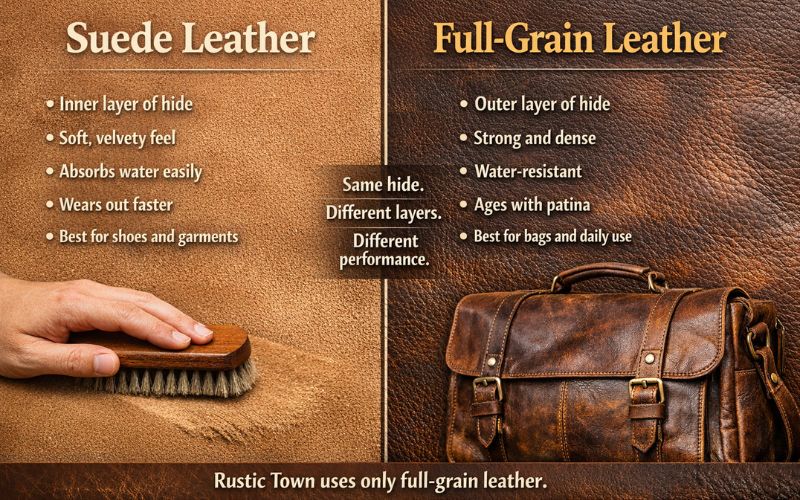
Full-grain leather is a natural material with living properties. The leather tote bags that look better at year ten than year one are not lucky - they are maintained. Understanding what happens to the leather at the material level explains why care matters and makes the routine feel purposeful rather than cosmetic.
What Happens to Full-Grain Leather Without Regular Care?
Full-grain leather contains natural oils within the grain structure that give it suppleness, surface resilience, and the ability to develop patina through use rather than deteriorating toward failure. These oils are not permanent. They deplete gradually through three routes: evaporation from the grain surface during carry in dry or heated environments, absorption into clothing and skin at the handle and strap contact points, and displacement during cleaning. A full grain leather tote carried daily for 12 months without any conditioning has lost a meaningful percentage of its natural oil content. In a moderate climate this depletion is slow. In a hot dry environment or a heated office it accelerates, and the first signs appear earlier.
The first signs of oil depletion in a leather tote are not dramatic. The leather does not suddenly crack. It begins to look slightly dull at the body panels - less depth in the surface tone, less of the subtle sheen that fresh full-grain leather carries. The handle areas, which receive the most heat and friction contact, develop a slightly rougher texture. The corner fold lines, which flex every time the bag is opened and closed, begin to show a faint surface webbing - the micro-cracking that precedes actual cracking if conditioning is not applied.
None of these early signs are irreversible. Conditioning at this stage restores the grain oil content, reverses the dullness, smooths the handle texture, and stops the micro-cracking from progressing. The risk is in not noticing these early signs and leaving the women's totes leather unconditioned until the micro-cracking has deepened into visible surface cracks - at which point conditioning improves the leather but cannot fully repair the cracked surface structure. The care routine is easier and more effective as prevention than as cure.
What Does Regular Conditioning Do to a Leather Tote Bag Over Time?
A leather tote purse conditioned every six months across its ownership period develops differently from one that is not. The conditioned bag develops a deeper richer patina because the grain oils that drive patina development are consistently replenished. The surface tone deepens more evenly across the full bag rather than developing the patchy uneven colouration that oil-depleted leather shows. The handle areas on a well-maintained leather tote bag for women develop a warm distinctly personal darkening that is the most characterful part of a well-used full-grain leather tote - the specific evidence of years of daily carry that makes the bag unmistakably hers.

|
Leather Condition |
Appearance |
Texture |
Crack Risk |
Action Required |
|
New (0-6 months) |
Uniform tone - fresh grain character |
Firm - breaking in |
None |
Wipe after use - first conditioning at 6 months |
|
Breaking in (6-18 months) |
Tonal variation beginning at handles |
Softening at contact points |
Very low |
6-monthly conditioning schedule begins |
|
Established (2-4 years) |
Rich patina developing |
Fully broken in and supple |
Low with conditioning |
Standard routine - monthly wipe, 6-monthly condition |
|
Mature (5-10 years) |
Deep personal patina - character piece |
Beautifully soft and responsive |
Low with consistent care |
Continue standard routine - annual seam inspection added |
|
Neglected (any stage) |
Dull uneven tone - rough handle areas |
Stiff at fold points |
Moderate to high |
Immediate saddle soap clean followed by double conditioning |
|
Cracked (severely neglected) |
Surface webbing or visible cracks |
Rough at crack locations |
Already present |
Deep conditioning + leather filler - professional help may be needed |
What Is the Complete Care Routine for Leather Tote Bags?
The care routine for leather tote bags has four tiers based on frequency: the daily habit, the weekly wipe, the monthly clean, and the 6-monthly conditioning. Each tier takes progressively more time and delivers progressively more maintenance value. All four together represent approximately 15 minutes of attention per month - which is all a full grain leather tote needs to remain in excellent condition for the full 15-20 year ownership period.
What Is the Daily Care Habit for a Leather Tote Bag?
The daily habit is an awareness rather than a routine. When you set your leather tote bag for women down for the evening, notice whether it is dry or whether it has been exposed to rain, wet surfaces, or significant humidity. If dry, no action needed. If damp at any surface point, blot gently with a dry cloth and leave the bag open in a room-temperature location to air dry before putting it away. Thirty seconds of attention that prevents moisture from settling into the grain overnight.
The other daily habit is where you store the bag. A leather tote purse stored on a hook or standing upright on a shelf stays in better condition than one crumpled in the bottom of a wardrobe under other bags. The upright or hanging position allows the bag to maintain its structural shape between uses and prevents the permanent crease lines that develop in leather stored in compressed or folded positions for extended periods.
What Is the Weekly Wipe Routine for a Leather Tote?
Once a week - or whenever the bag has had a particularly active week of carry - wipe the full exterior with a clean dry soft cloth. This removes the surface accumulation of dust, ambient particles, and the light contact residue from surfaces the bag has rested on throughout the week. It also gives you a regular close-up view of the leather surface that makes it easy to notice the early signs of dryness or staining before they become established problems. A women's totes leather bag wiped weekly looks consistently cleaner than one that only gets attention when it visibly needs it.
What Is the Monthly Clean for a Leather Tote Bag?
Once a month wipe the full exterior of the leather tote bag with a slightly damp cloth - barely damp, not wet - covering all exterior leather panels including the base, the handles, and the strap. Allow the bag to air dry completely at room temperature before storing. Do not rush the drying with a hair dryer, radiator, or direct sunlight. Room temperature air drying preserves grain oil content. Heat drying depletes it.
Pay particular attention to the base panel of the leather tote purse during the monthly clean. The base is the contact surface with every desk, floor, and table the bag rests on throughout the month. It accumulates the most environmental contact residue and is the area most likely to show premature wear without regular cleaning. A clean conditioned base panel on a full grain leather tote lasts as long as the main body panels. A neglected base panel shows wear within two to three years that the rest of the bag does not show for a decade.
|
Frequency |
Action |
Method |
Time |
What It Prevents |
|
Daily (if needed) |
Blot moisture - air dry |
Dry soft cloth - blot only - room temperature air dry |
30 seconds |
Moisture settling into grain overnight - water marking |
|
Daily |
Correct storage position |
Hang or stand upright - never crumpled |
10 seconds |
Permanent crease lines from compressed storage |
|
Weekly |
Dry cloth exterior wipe |
Soft dry cloth across all exterior surfaces |
1 minute |
Dust and contact residue accumulation becoming grime |
|
Monthly |
Damp cloth clean - full exterior |
Barely damp cloth - complete air dry before storing |
5 minutes |
Deep-set grime, handle oil accumulation, base panel contamination |
|
Every 6 months |
Full conditioning treatment |
Beeswax or lanolin conditioner - all exterior surfaces |
10-15 minutes |
Grain oil depletion leading to dullness, roughness, and cracking |
|
Annually |
Seam and hardware inspection |
Check stitching at handle attachments, base corners, zip channels |
5 minutes |
Undetected early seam wear becoming structural failure |
How to Condition a Leather Tote Bag: A Complete Step-by-Step Guide
Conditioning is the most important single care action for any leather tote bag for women. Done correctly every six months it keeps the leather supple, deepens the patina, and prevents the grain drying and cracking that ends the life of neglected leather tote bags prematurely. The process is straightforward and takes 15 minutes including the absorption time.
Step 1. Choose the right conditioner for your leather tote.
Two conditioners work for full grain leather tote bags: beeswax conditioner and lanolin conditioner. Beeswax conditions effectively without significantly darkening the leather - right for lighter tan or camel tones where you want to maintain the original colour character while deepening it naturally. Lanolin conditions more deeply and is particularly effective in dry climates or for leather tote bags that have been exposed to extended heat or air conditioning. It darkens the leather slightly more than beeswax. Both are appropriate for regular conditioning. Avoid silicone sprays - they seal the grain rather than conditioning it.
Step 2. Clean the bag before conditioning - never condition over grime.
Apply conditioner to a clean surface only. A leather tote purse with surface grime or contact oil accumulation will seal that contamination into the grain if conditioned without cleaning first. Do the monthly damp cloth clean and allow the leather to dry fully before beginning the conditioning step. This allows the conditioner to penetrate the grain correctly rather than sitting on top of a contaminated surface layer.
Step 3. Apply a small amount of conditioner to a soft cloth - not directly to the leather.
Squeeze or scoop a small amount of conditioner onto a clean soft cloth - a cotton flannel, a clean t-shirt section, or a dedicated leather care cloth. Never apply conditioner directly from the tin or bottle onto the leather tote bag surface. Direct application creates uneven coverage with concentrated spots that absorb differently from the surrounding leather, producing a blotchy appearance during the absorption period.
Step 4. Apply in small circular motions across the full exterior surface.
Work the conditioner into the leather in small circular motions, covering the full exterior panel by panel. Start with the main body panels, then the base, then the handles, then the strap if present. The circular motion works the conditioner into the grain rather than just coating the surface. Apply with light consistent pressure - not heavy rubbing, which generates heat that counteracts the conditioning effect on women's totes leather.
Step 5. Give specific attention to the handle areas and base corners.
The handles of a leather tote bag for women used daily receive more mechanical stress and more hand-contact heat than any other part of the bag. They deplete grain oils fastest and need the most conditioning attention. Spend an extra 30 seconds working conditioner into each handle, including the underside where hand contact is most intense. The base corners - the fold points that flex every time the bag is lifted and set down - are the second-highest depletion area and need the same additional attention.
Step 6. Allow the conditioner to absorb for 10-15 minutes before buffing.
After full application, leave the leather tote purse to sit at room temperature for 10-15 minutes. During this time the conditioner penetrates from the surface into the grain structure, replenishing the oil content throughout the leather thickness rather than just at the surface. Do not use the bag during this absorption period. Do not apply heat to accelerate absorption.
Step 7. Buff lightly with a clean dry cloth.
After 10-15 minutes, buff the full exterior surface with a clean dry cloth using light even strokes. This removes any excess conditioner that has not been absorbed and brings up the surface sheen that conditioned full grain leather tote bags develop immediately after treatment. The buffed surface should look richer and slightly deeper in tone than before conditioning - the visual confirmation that the grain has absorbed the conditioner correctly.
Step 8. Allow 24 hours before carrying.
Leave the conditioned leather tote bag to rest for at least 24 hours before carrying. The final stages of conditioner absorption continue for several hours after buffing and the leather needs this settling time to reach its fully conditioned state. A bag carried immediately after conditioning transfers residual conditioner onto clothing at the contact points - entirely avoidable with a 24-hour rest period.

Rustic Town's women's totes leather collection - full-grain leather that rewards the care routine described in this guide with 15-20 years of increasingly beautiful daily carry.
How Do You Handle Specific Stains and Damage on a Leather Tote Bag?
Every leather tote bag for women used as a genuine daily carry will encounter stains, water exposure, and incidental surface damage across its ownership period. The response speed and the correct method for each type of incident determines whether the bag surface is restored or permanently marked. Here is the specific response for every common damage scenario.
What Do You Do When a Leather Tote Bag Gets Wet in Rain?
Rain exposure is the most common weather incident for a leather tote bag used for daily carry and the one most people handle incorrectly. The instinctive response is to wipe the surface dry as quickly as possible. This is wrong. Rubbing a wet leather surface when the grain is softened by moisture creates surface scuffing that leaves permanent marks. The correct response is: blot gently with a dry cloth to remove surface water without rubbing. Then leave the leather tote purse to air dry completely at room temperature away from any heat source. Once fully dry - which takes 12-24 hours depending on how wet the bag got - apply conditioner to the full exterior. Rain water depletes grain oils as it evaporates and conditioning immediately after drying restores what the rain removed.
What Do You Do About Oil or Grease Stains on a Leather Tote?
Oil and grease stains on leather tote bags need an immediate response before the oil penetrates fully into the grain. The correct immediate response is to blot the stain with a dry cloth - never rub, which spreads the oil across a wider surface area and drives it deeper into the grain simultaneously. After blotting, sprinkle a small amount of cornstarch or talcum powder over the stain and leave for 4-6 hours. The powder absorbs the remaining surface oil from the grain. Brush away the powder gently and assess the stain. For light oil contact this process removes it entirely. For heavier oil saturation the grain will have absorbed some oil permanently, which over time integrates into the patina of the full grain leather tote rather than remaining as a discrete stain.
What Do You Do About Ink Marks on a Leather Tote Purse?
Ink marks on a leather tote purse are among the hardest stains to treat because ink penetrates the grain rapidly and bonds chemically with the leather fibres. Isopropyl alcohol on a cotton bud - applied very gently to the ink mark only, not to the surrounding leather - can lift fresh ink before it fully sets. This works best within the first 30 minutes of the mark occurring. For set ink, a leather-specific ink remover product applied according to the manufacturer's instructions is the most effective approach. Do not use acetone, nail polish remover, or household solvents on leather tote bags - these strip the surface coating, bleach the grain, and damage the leather structure permanently.
How Do You Handle Colour Transfer Stains on a Leather Tote?
Colour transfer - dye from dark clothing or denim transferring onto the leather surface of a leather tote bag for women - is a common issue with light tan or camel leather totes worn against dark-dyed clothing. The transfer typically appears as a blue or grey tonal change on the leather surface at contact areas. A leather-specific colour transfer cleaner applied according to directions handles fresh transfer effectively. For established transfer that has been present for weeks or months the dye has partially integrated into the grain. In practice most colour transfer on women's totes leather in tan shades deepens over time and integrates into the overall patina character of the bag rather than remaining as a discrete stain.
|
Incident |
Immediate Response |
Follow-Up Action |
What Not to Do |
Recovery Likelihood |
|
Light rain |
Blot gently - air dry at room temp |
Condition after fully dry |
Rub wet surface - use heat to dry |
Full recovery - no permanent mark |
|
Heavy soaking |
Blot - stuff with newspaper - slow air dry |
Condition twice after fully dry - 1 week apart |
Accelerate drying with heat |
Good - some tonal change possible but minimal |
|
Oil or grease |
Blot immediately - cornstarch overnight |
Leather cleaner if residue remains |
Rub stain - use water to dilute |
Good if caught immediately - excellent if within minutes |
|
Ink mark |
Isopropyl on cotton bud - fresh ink only |
Leather ink remover for set ink |
Acetone, nail polish remover, household solvents |
Good if fresh - partial if set more than 30 minutes |
|
Colour transfer (denim) |
Leather colour transfer cleaner |
Condition after treatment |
Scrub with water - bleach-based cleaners |
Partial - fresh transfer responds better than established |
|
Scratch or scuff |
Finger rub - body heat and natural oils remove light scuffs |
Conditioner over area after treatment |
Panic - most light scuffs self-resolve with handling |
Excellent for light scuffs - deeper scratches partially improve |
What Products Should and Should Not Be Used on Leather Tote Bags?
The leather care product market is full of options, some of which genuinely help leather tote bags and some of which cause the surface damage they claim to prevent. Understanding which category each product falls into prevents the well-intentioned care routine that actually accelerates leather deterioration.
What Products Should You Use on a Leather Tote Purse?
Beeswax leather conditioner.
The standard conditioning choice for leather tote bags in most climates. Penetrates the grain effectively, restores suppleness, provides a light protective surface finish, and does not significantly darken the leather. Look for products with beeswax as the primary ingredient - not products where beeswax is listed alongside silicone or petroleum derivatives.
Lanolin conditioner.
Deeper conditioning action than beeswax - appropriate for leather tote bags used in dry climates, heated office environments, or those that have been exposed to extended air conditioning. Darkens the leather slightly more than beeswax. The correct choice when the leather shows early dryness signs or when the full grain leather tote has been neglected for more than 12 months without conditioning.
Leather saddle soap.
For deep cleaning of women's totes leather that has accumulated grime or surface contamination beyond what a damp cloth removes. Saddle soap lifts deep-set dirt without stripping the grain. Always follow saddle soap cleaning with a full conditioning treatment - saddle soap removes surface oils alongside grime and the conditioning step restores the grain balance.
Leather-specific stain removers.
For ink, oil, and colour transfer incidents where the standard clean is insufficient. Always test on a hidden interior area of the leather tote purse before applying to the visible exterior surface.
What Products Should You Never Use on a Leather Tote Bag?
Silicone-based leather sprays.
Silicone sprays coat the surface of leather tote bags with a film that repels water and creates a temporary shine. They do not condition the grain - they seal it. Under the sealed surface the grain continues to deplete its natural oil content without the ability to absorb replacement conditioning. A leather tote purse treated with silicone spray looks good for three to six months and then develops dullness and cracking of severely oil-depleted leather faster than an untreated bag.
Household cleaning products.
Baby wipes, furniture polish, all-purpose cleaners, and dish soap are among the most commonly used household products on leather tote bags and among the most damaging. These products contain surfactants, solvents, and fragrance chemicals that strip the grain surface and damage the leather fibre structure with repeated application. The leather may look cleaner immediately after treatment but within weeks the surface shows tonal unevenness and premature ageing.
Heat sources for drying.
Hair dryers, radiators, heated clothes airers, and direct sunlight are the fastest way to age leather tote bags prematurely. Heat accelerates the evaporation of grain oils beyond the rate of normal daily depletion, causing the grain to dry unevenly and rapidly. A women's totes leather bag dried with a hair dryer after rain exposure will show surface stiffness and tonal blotchiness within months rather than years.

Rustic Town's leather tote bag for women collection - full-grain leather that responds to the correct care products and routine with decades of beautiful daily carry.
How Do You Store a Leather Tote Bag Correctly Between Uses?
Storage is the care dimension most women with leather tote bags overlook because it does not feel like active maintenance. The way a leather tote purse is stored between uses determines its structural shape across years of ownership and whether the leather develops evenly or shows the deformation and crease lines of poor storage habits.
Store upright or hanging - never crumpled or compressed.
A leather tote bag for women stored crumpled under other bags in a wardrobe bottom develops permanent crease lines at the compression points within weeks. Leather in a sustained compressed position conforms to that position through the grain structure - and once a compression crease is established in leather, conditioning softens it but cannot remove it fully. Store the leather tote bag upright on a shelf or hanging from a hook at its natural shape.
Stuff lightly to maintain shape when stored for extended periods.
A full grain leather tote stored empty for weeks or months may develop a slight inward collapse at the side panels as the leather relaxes without internal support. For bags stored unused for two weeks or more, stuff lightly with acid-free tissue paper or a clean soft cloth to maintain the bag's natural open shape. Do not use newspaper, which transfers ink to the interior lining.
Store in a dust bag away from direct light.
Direct sunlight and strong artificial light cause UV fading in leather - a progressive bleaching of the surface colour that is most visible on dark brown and tan leather tote bags stored on open shelves near windows. A cotton or linen dust bag provides UV protection and prevents dust accumulation between uses. Most quality women's totes leather bags come with a dust bag - use it for any storage period of more than a few days.
Keep away from plastic bags and airtight containers.
Leather needs to breathe. A leather tote purse stored in a sealed plastic bag or airtight container cannot breathe, and the humidity that builds inside the sealed environment promotes mould growth on the leather surface and lining. Always use a breathable fabric dust bag for leather storage, never plastic.
How Do You Restore a Neglected Leather Tote Bag?
If you have inherited a leather tote bag for women that has been stored without care, bought a vintage full grain leather tote that needs restoration, or simply realised your own bag has been carried without maintenance for two or more years, the restoration process is more intensive than the standard care routine but follows the same principles. Here is the sequence for restoring a neglected leather tote purse to its best possible condition.
|
Restoration Step |
Method |
Product |
Time |
Expected Result |
|
Assessment |
Examine full exterior under good light - identify crack locations, stain areas, overall dryness level |
None |
5 minutes |
Clear picture of what restoration is addressing |
|
Deep clean |
Saddle soap applied with damp sponge in circular motions - wipe with damp cloth - air dry fully |
Leather saddle soap |
15 min + drying |
Removes deep-set grime, old conditioner residue, surface contamination |
|
First conditioning |
Heavy lanolin application across all surfaces after clean and full dry |
Lanolin conditioner |
15 min + 24hr absorption |
First restoration of grain oil content - leather visibly softens and deepens in tone |
|
Second conditioning (48 hours later) |
Standard beeswax application after first conditioning has fully absorbed |
Beeswax conditioner |
15 minutes |
Seals and builds on lanolin's deep conditioning - surface character begins to restore |
|
Crack treatment (if present) |
Leather repair filler applied to cracks after second conditioning - blend carefully |
Leather repair filler (colour matched) |
20-30 minutes |
Cracks filled and blended - not invisible but significantly improved |
|
Ongoing maintenance |
Standard 6-monthly conditioning schedule from this point |
Beeswax conditioner |
10 min every 6 months |
Continuous improvement from restored baseline - no further deterioration |
Not every neglected leather tote bag can be fully restored to new condition - and realistic expectations matter. Deep cracks present for years cannot be fully repaired through conditioning alone, and significant UV fading cannot be reversed without dye treatment requiring specialist skills. What the restoration process above achieves is: the maximum possible softening and re-suppleness of the leather, the deepest achievable patina restoration, and the arrest of any ongoing deterioration. A neglected full grain leather tote restored with this process and then maintained correctly will continue to improve rather than deteriorate.
Frequently Asked Questions: Caring for Leather Tote Bags
Q: How often should you condition a leather tote bag?
A: Every 6 months as a standard routine. More frequently - every 3-4 months - in dry climates, heated environments, or air-conditioned offices where ambient humidity is consistently low. A leather tote bag used in a dry heated environment benefits from more frequent conditioning because the drying conditions accelerate grain oil depletion beyond what the standard schedule replenishes.
Q: What is the best conditioner for a leather tote bag?
A: Beeswax conditioner for standard maintenance without significant colour change. Lanolin conditioner for deeper conditioning, dry climates, or bags that have been neglected. Both penetrate the grain effectively and replenish natural oil content. Avoid silicone-based products that seal the grain rather than conditioning it.
Q: Can you use baby wipes on a leather tote bag?
A: No. Baby wipes contain surfactants, fragrance chemicals, and preservatives that strip the grain surface with repeated use and cause premature surface deterioration. A barely damp cloth with clean water is the correct cleaning tool for regular maintenance.
Q: How do you get a water stain out of a leather tote bag?
A: If the stain is fresh, blot gently and allow to air dry completely at room temperature. Once dry, condition the affected area - most fresh water marks disappear completely after conditioning because the dried water was simply depleting the grain at the contact point. Set water marks respond to a barely damp cloth wipe across the full panel (not just the mark) followed by full air drying and conditioning - treating the full panel evens out the tonal difference between the marked and unmarked areas.
Q: How do you clean the interior of a leather tote bag?
A: Empty the bag completely. Turn out any interior pockets. Brush out loose debris with a dry soft brush. Wipe the interior lining with a barely damp cloth if it is fabric-lined. For leather interiors, use the same damp cloth wipe as the exterior followed by full air drying. Never submerge or soak the bag interior and never use soap or cleaning products inside the bag that could transfer onto contents in future use.
Q: How do you store a leather tote bag long term?
A: Condition the bag before long-term storage. Stuff lightly with acid-free tissue paper to maintain shape. Store in a breathable cotton or linen dust bag - never plastic. Keep away from direct light, heat sources, and damp environments. Store upright or hanging - never compressed under other bags. Check and re-condition every 6 months even during storage.
Q: Can scratches on a leather tote bag be fixed?
A: Light surface scuffs on full-grain leather often self-resolve through normal handling - the body heat and natural oils from hand contact buff out shallow surface marks. Apply conditioner to any scratched area and work it in with a fingertip using circular motions and light pressure. For deeper scratches that do not respond to conditioning, a colour-matched leather repair product can fill and blend the scratch into the surrounding leather surface.
Q: What is the best way to clean handles on a leather tote bag?
A: The handles of a leather tote bag are the highest-use and highest-contact leather surfaces on the bag. Monthly wipe with a slightly damp cloth followed by full air drying. Conditioning every 6 months with extra attention - 30 additional seconds of conditioning worked into each handle including the undersides and the stitching at the attachment points. For handles with significant grime build-up from daily hand contact, saddle soap applied with a damp cloth followed by conditioning restores the surface effectively.
The Short Answer: How Do You Make a Leather Tote Bag Last?
You make a leather tote bag for women last by keeping the grain oils replenished, keeping the surface clean, storing it correctly, and responding to stains and damage immediately rather than hoping they resolve on their own. The full routine - daily blot if wet, weekly dry wipe, monthly damp wipe, 6-monthly conditioning - takes approximately 15 minutes of attention per month across the ownership period. That is the entire investment required to keep a full grain leather tote in excellent condition for 15 to 20 years.
The leather tote bags that look extraordinary at year ten are not rare or lucky. They are maintained. The patina that develops on a well-cared-for leather tote purse through years of daily carry is one of the most quietly remarkable things about owning a quality leather bag - the surface character that is entirely specific to its owner's life, routes, seasons, and carrying habits. No other bag material develops this. And it only happens when the leather is cared for correctly from the beginning.
Start the routine on day one. Condition at six months. Repeat. The rest takes care of itself across the full length of a women's totes leather ownership that no synthetic bag at any price can match.
Find Rustic Town's full range of leather tote purse styles - full-grain leather, multiple colours and formats, built to reward the care routine this guide describes.